Select a site alphabetically from the choices shown in the box below. Alternatively, browse sculptural examples using the Forward/Back buttons.
Chapters for this volume, along with copies of original in-text images, are available here.


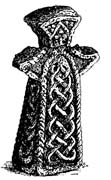
Object type: Cross-shaft and lower part of -head in several fragments [1]
Measurements:
(a) lower part of shaft:
H. 44.5 cm (17.5 in); W. 23 > 18 cm (9 > 7 in); D. 20 > 14 cm (8 > 5.5 in)
(b) lower head fragment in two joining pieces:
L. 14 cm (5.5 in); W. 12 cm (4.75 in); D. 13 > 12 cm (5 > 4.75 in)
L. 15 cm (6 in); W. 10.5 cm (4.1 in); D. 5.5 cm (2.2 in)
(c) lower head fragment:
L. 16.5 cm (6.5 in); W. 15 cm (6 in); D. 11.5 cm (4.5 in)
(d) upper shaft fragment:
L. 12 cm (4.75 in); W. 8 cm (3.2 in); D. 5 cm (2 in)
Stone type: Pale yellowish brown (10YR 6/2), fine- to coarse-grained (0.2 to 1.0 mm, but mostly in the range 0.4 to 0.6 mm; a few clasts up to 1.5 mm across), sub-angular (some grains sub-rounded), clast-supported, quartz sandstone. ?Milnrow Sandstone, Lower Coal Measures Sandstone, Carboniferous
Plate numbers in printed volume: Ills. 139-43, 148-59
Corpus volume reference: Vol 9 p. 76-7
(There may be more views or larger images available for this item. Click on the thumbnail image to view.)
Cross-shaft of type g/h, with head of type E with fan-shaped (penannular) terminals. See Allen 1895, fig. on 150, for a drawing of the monument's form in the late nineteenth century. The following description assumes that the surviving fragments have been restored to their late nineteenth-century state.
A (broad): The face is divided into two panels which are bordered laterally by a cable moulding which curves at the bottom to form the swag of a type g shaft. At the top it curves to a point within the cross-head. The two panels are divided by a plain moulding. The upper panel carries a plait, which narrows from four to three cords as a result of two of the strands joining, whilst the lower is decorated with two interlinked closed-circuit loops. The fragmentary lower arm of the cross-head carries the stub of a ring originally connecting the arms of the cross.
B (narrow): The single panel, with cabled borders and swag, carries a three-strand plait.
C (broad): The single panel has cabled borders, pointed top and swag as on face A. It carries a four-strand plait.
D (narrow): The single panel, with cabled borders and swag as on face B, is decorated with a type 2 meander pattern; there is now no trace of the median-incised strands drawn by Allen 1895.
Round-shaft (see Chapter V, p. 33, and Disley (Lyme Hall) 1 above). Though smaller in size, it is closely related to Disley Lyme Hall 1 in the overall shaping of the shaft and head, and in its decorative combinations. The interlinked loops recurs within the round-shaft group at Alstonefield, Chebsey and Ilam (Pape 1945–6, 30, 31, 32, 34); like the meander pattern, which is found in median-incised form on Lyme Hall 1, it is a characteristic Viking-age motif.
