Select a site alphabetically from the choices shown in the box below. Alternatively, browse sculptural examples using the Forward/Back buttons.
Chapters for this volume, along with copies of original in-text images, are available here.


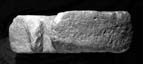
Object type: Cross-shaft and lower part of -head with fragment of cross-arm [1]
Measurements:
(a) shaft and lower arm:
H. 88 cm (35.5 in); W. shaft 30 > 23 cm (11.75 > 9 in); lower arm 49 cm (19.25 in); D. shaft 26 > 17 cm (10 > 6.75 in); lower arm 15 cm (6 in)
(b) cross-arm:
H. 17 cm (6.5 in); W. 46 cm (18 in); D. 14 cm (5.5 in)
Stone type:
(a) shaft and lower arm: Colour undetermined, medium- to coarse-grained (0.3 to 1.0 mm, but mostly in the range 0.4 to 0.6 mm; a few clasts up to 1.5 mm across), sub-angular (some grains sub-rounded), clast-supported, quartz sandstone. ?Milnrow Sandstone, Lower Coal Measures Sandstone, Carboniferous.
b) cross-arm: Colour undetermined, fine- to coarse-grained (0.2 to 1.0 mm, but mostly in the range 0.4 to 0.6 mm; a few clasts up to 1.5 mm across), sub-angular (some grains sub-rounded), clast-supported, quartz sandstone; a few small flakes of white mica. ?Milnrow Sandstone, Lower Coal Measures Sandstone, Carboniferous.
[infill stones: Pale brown (5YR 5/2), sub-angular to sub-rounded, with a few rounded grains, 0.3 to 0.6 mm, clast-supported, quartz sandstone. ?Sherwood Sandstone Group, Triassic]
Plate numbers in printed volume: Ills. 128-32, 137-8
Corpus volume reference: Vol 9 p. 74-6
(There may be more views or larger images available for this item. Click on the thumbnail image to view.)
There are conflicting accounts of the discovery of Disley Lyme Hall 1, 2 and 4; Earwaker indeed managed to record two entirely different versions in the same volume (Earwaker 1877–80, II, 101, 313). According to one tradition the stones were discovered during ploughing in a field near Disley church in c. 1845 and, by 1848, as having been removed to the garden of a cottage at High Lane by the 'late Richard Orford, Esq.' ((—) 1848, 337; Earwaker 1877–80, II, 101; (—) 1914, 267). This account carries conviction in that the 1848 narrative was written within three years of the event by Charles Wyatt Orford, a close relative of the churchwarden Richard Orford. In 1876 the crosses are described as being in the chapel at Lyme Hall (Renaud 1876, 144), having presumably been claimed by the Legh family; by 1887 however the carvings had been removed to the garden of the Hall ((—) 1888b, 319). Interestingly, this latter account merely states that they had been found 'in the neighbourhood'.
An alternative tradition, which was certainly circulating by the 1870s (Earwaker 1877–80, II, 313; (—) 1911, 216–17; Thacker 1987, 291), claims that they were found during gorse clearance at Badgers Clough (on Black Farm), Higher Disley, which is about 1.6 miles (2.5 km) from Lyme Hall at SJ 989835. This account may reflect confusion caused by the fact that Badgers Clough had been an Orford residence before Charles Wyatt Orford moved to High Lane (Marshall 1975, 68). Yet the version of this alternative tradition produced for the Manchester Evening News of 31 May 1890 by the local antiquary Isaac W. Boulton does give a very circumstantial narrative, identifying the finder as Thomas Armfield (Sharpe 2002, 102, 104–5).
Cross-shaft of type g/h; head of type E with fan-shaped terminals
A (broad): The single full-length panel is bordered by a cable moulding which curves at the bottom to form the swag of a type g shaft. At the top it curves to a point within the cross-head. The decoration appears to be made up of three elements. At the top are two crossing strands which terminate at both ends in a loose curl; three pellets are set around the crossing. Below are two further crossing strands, with similar terminations, whose crossing is enclosed by a circle. At the bottom of the panel are two linked knots, a pattern F loop above a half pattern E terminal. Triquetra appear on the surviving parts of the lower head, which appears to have carried a ring — probably on a cross-head of type E8 with wide curve. The fragmentary cross-arm carries two counter-pointed curves.
B (narrow): A single panel of four-strand plait bordered laterally and at the base by a cable moulding. The lower part of this border forms a swag.
C (broad): The panel shape and borders are as on face A. At the top is an asymmetrical loop linked to two parallel vertical rows of interlinked Stafford knots (simple pattern E). On the remaining parts of the lower head are curled serpentine forms, whilst the fragmentary cross-arm carries a triquetra.
D (narrow): A single panel, with cabled borders and swag as on face B, decorated with a type 3 meander pattern with median-incised strand terminating at the bottom in a curl/spiral. This ornament continues under the lower arm.
The carving formed the upper part of a round-shaft (see Chapter V, p. 33). Though this stone differs in size from Disley Lyme Hall 2, they have much in common in their shape and decoration and thus could have functioned as two components of a composite monument.
Several writers have associated these crosses with other existing sockets or shafts. Renaud (1876, 72, 144), followed by Crofton (1903, 47–8), asserted that they 'formerly stood in a double socketed base above Disley ... known as the Jordan Law crosses. The socket stone was taken to Stockport rectory and converted into a grindstone when the crosses were removed to Lyme Hall'. This is so much at odds with the accounts quoted above that it can be discounted, particularly since the Jordan Law stone appears to have carried a single socket. Cox (J. 1904, 57) speculated that they might have been part of a composite monument which is now represented only by the double socket known as the Dipping or Plague Stone on Whaley Moor (SJ 995817); this possibility can also be dismissed since the sockets on that stone are square (see Sharpe 2002, 107). The most popular suggestion, however, is that they once formed part of the same monument as the 'Bow stones' — Disley Lyme Handley 1 and 2 (Rosser 1958, 142). The discovery of the double socket in Disley Church Field in 1957 led to the further suggestion that the 'Bow stones' themselves, together with these Lyme Hall squared shafts and cross-heads, formed a single composite monument (Bu'lock 1957, 31; Marshall 1975, 67–9). The earliest description of the find-spot certainly suggests that they may have had the same provenance as the Disley Church Field socket; this non-churchyard provenance is a feature of the Cheshire round-shafts (see Chapter V, p. 36). The shafts and the socket do, however, differ in their geology (see discussion under Disley Lyme Handley below, p. 78).
The manner in which the shaft panel, with curved top, intrudes into the lower arm of a fan-shaped cross-head is not only paralleled on Lyme Hall 2 below but also occurs on Cheadle 1 and probably also at Rainow 1 (Ills. 71, 73, 139–41, 240). Both Cheadle and Rainow are probably round-shafts and the same feature is echoed on more complete crosses of this shape from Leek and Ilam in Staffordshire (Brown, G. 1937, pls. XCVIII, C). For discussion of fan- (or penannular-) shaped arms with connecting rings see Chapter V, pp. 31, 33.
Most of the motifs on this cross are typical of the ornament of decorated round-shafts in Cheshire and Staffordshire. Thus the combination of meander pattern and ring-encircled plait (with curved terminals) recurs nearby on the round-shafts Sutton Ridge Hall 1 and Rainow 1 whilst the curving end to the meander pattern is found again on the round-shaft at Ilam in Staffordshire (Ills. 240–1, 314–15; Pape 1945–6, 34). Both of these motifs are familiar decorative forms in the Viking period (Bailey 1980, 72). The other main decoration of linked Stafford knots is also a common type and is combined with meander pattern on a round-shaft at Stoke on Trent (Pape 1946–7, 36).
The cross-head clearly carried a Viking-period ring (see reconstruction in Collingwood 1927a, fig. 14 (11) which more accurately incorporates the arm fragment than the drawing by Earwaker (1877–80, ii, fig. on 312)). Like Lyme Hall 4 it carries triquetra decoration on face A. On face C there are snakes with curled bodies; these can be readily paralleled in Viking-age art on Man and across Yorkshire (Kermode 1907, pls. LII–LIII; Collingwood 1915, 198; Coatsworth 2008, ill. 395; Lang 2001, ills. 125, 129, 251, 646, 648, 765).
The motif of ring-encircled crossing strands recurs regionally on Bolton le Moors 1 (Ill. 411). More significantly, perhaps, the straggling curled ends to the strands resembles work at Leeds and Staveley, with Otley providing a tighter version of the same kind of extended curling terminal (Coatsworth 2008, ills. 492, 606, 713). At least some of these parallels have long been recognised as reflexes of the Ringerike style (Kendrick 1949, 107–8; Bu'lock 1960b, 52; Wilson and Klindt-Jensen 1966, 142; Fuglesang 1980, 63, 64, 107). If such a Scandinavian-derived inspiration were accepted here, then it would suggest a late tenth- or eleventh-century date for this Lyme Hall shaft. But, if so, it must be said that the sculptor has totally failed to capture the essence of the Scandinavian style.
