Select a site alphabetically from the choices shown in the box below. Alternatively, browse sculptural examples using the Forward/Back buttons.
Chapters for this volume, along with copies of original in-text images, are available here.


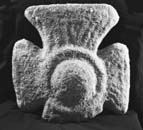
Object type: Cross-head
Measurements: H. 41 cm (16 in); W. 39.5 cm (15.5 in); D. 10 cm (4 in)
Stone type: Yellowish grey (5Y 7/2), poorly sorted, clast-supported, pebbly, quartz sandstone; a few white feldspar clasts. The sub-angular to sub-rounded clasts range from medium-grained (0.3 mm) to pebbly (2.0 cm), but are mostly in the range coarse-grained (0.6 mm) to very coarse-grained (2.0 mm). Millstone Grit, Carboniferous
Plate numbers in printed volume: Ills. 447-50
Corpus volume reference: Vol 9 p. 172-3
(There may be more views or larger images available for this item. Click on the thumbnail image to view.)
See Colne (Greenfield Sewage Works) 1 above, with which this stone has often been confused. The Colne and Nelson Times for 30 August 1884 describes 'a Maltese cross' having been found a fortnight previously at the sewage works on the local Swinden estate, four feet from the surface. The 'Maltese' description, the fact that 'one side' is reported to have been broken off, together with the similarity of the recorded dimensions — all fit this sculpture. The article states that the cross was then in the possession of 'Mr James Carr, Solicitor, of Colne' who can be identified with the author of Annals of Colne (1878).
The current Librarian, Christine Bradley, kindly supplied the following information about its post-discovery history which she recorded at the time of the 2005 donation. James Carr took the cross-head to his house in Thornton Craven, Yorkshire, and both house and carving then passed into the possession of the Landless family. The stone was subsequently used as a grave-marker for a family member in East Marton churchyard in Yorkshire. In June 2005 the family agreed to its display in Colne Public Library. Before its donation a photograph of the stone by Herbert Hindle had been on display in the Library.
Cross-head of type B8 with narrow curved armpits and curved terminals
A (broad): At the centre of the head is a large boss, protruding some 5 cm from the plane of the arms, surrounded by a single moulded ring. The boss may have carried fluting. Though worn, the arms clearly carried decoration of a form similar to that displayed on the other face, set within a border moulding.
B and D (narrow): Possible evidence of interlace decoration set within a moulding frame
C (broad): At the centre of the head is a ring-encircled boss, less bold but more domed than on the other face; it is set slightly off-centre. The decoration in the arms is framed by a moulding and consists of straight mouldings which run, ray-like, parallel with the long sides, making an angular turn at the arm end to run parallel to the short side of the arm. The result is a series of triangular forms boxed within each other.
Cramp (1984, 8, 240) has noted that several 'architectural' uses of cross type B8 are found in Northumbria, and her discussion of Corbridge 5 (ibid., 240, pl. 238.1349), which has precisely this form, attributes it to the eleventh century; this is also the date given to the similar gable finial-cross from St Crux, York, by Lang (1991, 115, ill. 400). Narrow V-shaped armpits are characteristic of late cross-heads with plates: see in particular the Lythe material in Yorkshire and Chollerton, Northumberland (Lang 2001, ills. 499–510; Cramp 1984, 239, pl. 236.1335). The decoration, which uses parallel mouldings rather than interlace, can be compared to Burton in Kendal 3 and Walton 1 in Cumbria (Bailey and Cramp 1988, ills. 189–192, 573, 575). This form of decoration is, however, widespread among other seemingly late carvings; it is evidenced, for example, at Kirkclaugh in south-western Scotland, Wooler in Northumberland and Stanbury in Yorkshire (Collingwood 1927a, fig. 226; Cramp 1984, pl. 229.1292; Coatsworth 2008, ills. 701–2). As a further indication of late date, Tweddle has commented on the popularity of analogous 'nested' geometric motifs in the East Midlands in the eleventh century (Tweddle et al. 1995, 233).
The very prominent boss and surrounding circle are typical of many carvings of the tenth and eleventh century from Lancashire at sites like Aughton, Bolton, Ribchester and Whalley (Ills. 413, 417, 445–50, 636–7, 697–700).
