Select a site alphabetically from the choices shown in the box below. Alternatively, browse sculptural examples using the Forward/Back buttons.
Chapters for this volume, along with copies of original in-text images, are available here.


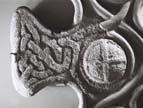
Object type: Part of cross-head
Measurements: H. 27 cm (10.5 in); W. 33 cm (13 in); D. 7.5 cm (3 in)
Stone type: Moderate yellowish brown (10YR 5/4), poorly sorted, clast-supported, quartz sandstone. The sub-angular to sub-rounded clasts range from medium-grained (0.3 mm) to very coarse-grained (1.5 mm), but are mostly coarse-grained in the range 0.5 to 0.8 mm. Millstone Grit, Carboniferous
Plate numbers in printed volume: Ills. 445-6
Corpus volume reference: Vol 9 p. 171-2
(There may be more views or larger images available for this item. Click on the thumbnail image to view.)
There has been confusion between this cross-head and Colne (Greenfield Sewage Works) 2 below. The caption in the Colne Library exhibition claims that the stone was found by Mr (Alderman) Mallinson, the Surveyor of the Local Board, who presented it to Colne Library in 1911. This presentation is recorded in the Minutes of the Library for that year (Edwards, B. 1988b, 24) and is thus better attested than the claim in the Northern Daily Telegraph for 20 September 1950 (see also Colne Times of 15 June 1951 and 22 September 1951) that the carving had been in the grounds of Alkincoats Hall and had been moved to the Library when a quantity of stones had been brought for building the base of the cenotaph in 1930. Subsequent enquiries in 1954 by the librarian Wilfrid Spencer in preparation for the Library's Diamond Jubilee established that it was found in either 1883 or 1885 at Greenfield Sewage Works (SD 872394) by Alderman Mallinson (see: Colne Times, 1915; Northern Daily Telegraph, 16 February 1955; summarised in Edwards, B. 1988b). An undated early twentieth-century manuscript in Colne Library refers to a cross in a garden in York Street which is where (according to local directories) Mallinson lived; presumably this represents its location in the late nineteenth and first decade of the twentieth century.
Of possible relevance is that Carr (1878, 110, 114) records two major nineteenth-century restorations at the church — a demolition and restoration in 1815 and another in 1856–7.
Only one arm and part of the central decoration of the cross-head survive. The head was of type E9 with expanded terminals.
A (broad): Within a moulded arris frame the surviving arm carries a half pattern F knot with added diagonals and an alternately joined terminal, and strands linking to adjacent arms. At the centre is an elaborate boss surrounded by two raised flanges and with a plain cross (type A1, in relief) laid over it; the cross overlaps the inner flange.
C (broad): This face is now inaccessible and the following description is based on a photograph by Dr R. Trench-Jellicoe. At the centre of the arm is a boss with surrounding circle. The arm is filled by a heavily abraded Stafford-knot ornament linked to (presumably similar) knotwork in the other arms. This is bordered by a rounded arris.
Like Colne 2 and many other Lancashire cross-heads of the tenth and eleventh century, this head has a prominent boss (see Aughton 1, p. 163). In shape it approaches the penannular form so popular in western Yorkshire and eastern Cheshire and Lancashire in the Viking period (see Chapter V, p. 33). Though relief crosses appear at the centre of several cross-heads, the raised cross on a boss, which is suggestive of metalwork, seems to be of late occurrence; a head from Dewsbury offers the closest parallel (Coatsworth 2008, ills. 221, 223).
