Select a site alphabetically from the choices shown in the box below. Alternatively, browse sculptural examples using the Forward/Back buttons.
Chapters for this volume, along with copies of original in-text images, are available here.


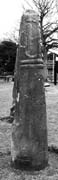
Object type: Part of round-shaft [1]
Measurements: H. 216 cm (85 in); W. (NW face) 29 > 22 cm (11.5 > 8.75); D. (SW face) 27 > 14 cm (10.5 > 5.5 in); Circumference 170 > 122 cm (67 > 48 in)
Stone type: Pale red (5R 6/2), medium- to coarse-grained (0.4 mm to 1.0 mm), but mostly in the range 0.4 to 0.6 mm; angular to sub-angular, clast-supported, quartz sandstone; a few grains of white (?kaolinised) feldspar. Millstone Grit Group, Carboniferous
Plate numbers in printed volume: Ills. 317-20, 327-8
Corpus volume reference: Vol 9 p. 127
(There may be more views or larger images available for this item. Click on the thumbnail image to view.)
Shaft of type g/h but with two horizontal mouldings encircling the shaft at the junction of cylindrical and rectangular sections. The rectangular sections each contain a single panel defined laterally by roll-moulding borders and, below, by a curved scallop moulding.
A (north-west): The only decoration visible are traces of a horizontal moulding linking the border mouldings at the top of the shaft.
B (south-west): Two horizontal mouldings, set one above the other and joining the vertical edge mouldings, are visible at the top of the shaft.
C (south-east): There are traces of two horizontal mouldings at the top, as on face B, with possible remains of interlace below.
D (north-east): Almost entirely cut away, but there is a horizontal bar at the top as on face A.
Round-shaft (see Chapter V, p. 33). In proportions and basic ornamental organisation this shaft closely resembles Sutton 3 whilst its later re-use as a gatepost mirrors the history of that other shaft. There is therefore a strong possibility that these two formed part of a pair such as recur, or can be deduced once to have existed, at Disley Lyme Handley and Disley Church Field (Ills. 160–1, 162). The horizontal bars near the top of the rectangular part of the shaft are only paralleled on Sutton 3 — though there is the possibility that Wincle Cleulow 1 may provide an analogy with its bar terminating the shaft decoration below the head (Ills. 362–5).
