Select a site alphabetically from the choices shown in the box below. Alternatively, browse sculptural examples using the Forward/Back buttons.
Chapters for this volume, along with copies of original in-text images, are available here.


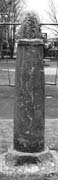
Object type: Part of round-shaft [1]
Measurements: H. 190 cm (74.5 in); of socket-stone 7 cm (2.75 in); W. (NE–SW axis) 27 > 23 cm (10.5 > 9 in); D. (NW–SE axis) 24 > 22 cm (9.5 > 8.5 in); Circumference (of base) 138 cm (55.5 in)
Stone type: Colour not determined; medium- to very coarse-grained (0.4 mm to 1.5 mm), but mostly in the range 0.5 to 0.9 mm; angular to sub-angular (a few grains sub-rounded), clast-supported, quartz sandstone. Millstone Grit Group, Carboniferous
Plate numbers in printed volume: Ills. 313-16, 325-6, 329-30
Corpus volume reference: Vol 9 p. 126-7
(There may be more views or larger images available for this item. Click on the thumbnail image to view.)
John Langdill has kindly clarified the nineteenth-century history of these stones which has been confused in some recent accounts. The Macclesfield Corporation Minutes for 7 January 1858 record the arrival of the stones in the Park: 'Resolved that the Old Macclesfield Market Cross and other ancient stones presented to the Corporation be placed in the Park'. Following a letter from 'An Antiquarian' in the Macclesfield Courier for 15 May 1858, complaining about the removal of an unspecified number of stones from their original sites to Macclesfield Park ('I refer to the Mere-stones or Boundary stones at Upton [2] and Ridge'), there follows a letter from Geo. Stewart (Master of Macclesfield School of Art) on 22 May which claims responsibility for their transfer, stating that the three shafts were removed from 'Ridge Hill Farm' where they were being used as posts for two gates, 'iron staples had been driven into them and one side of at least one post had been squared off'. Reference is also made by Stewart to a socket-stone being used as a henhole at the farm. In the same 22 May edition 'An Admirer of Antiquities' refers to three Mere-stones having been removed from 'Ridge Farm' where they had been used as clap stumps for two gates: 'Application for their removal was first made by T. R. Daintry esq., a relative of the owner. When that gentleman went to inspect them I accompanied him'. He also notes that one of the three shafts was in a pile of rubbish. A former mayor was later to stake a claim to be the moving force behind the removal from 'Ridge Hall Farm' (Bullock 1877, 41).
The original site appears to have been at Ridge Hall Farm (SJ 940705), since details in Stewart's letter suggest that his 'Ridge Hill' provenance was an error; this is confirmed by Earwaker (1877–80, II, 449) and earlier by Finney (1871, 39–40) who noted that it is the site of a former moated mansion.
Shaft of type h with division between rectangular and cylindrical sections marked by a double horizontal moulding encircling the shaft. Lateral roll-moulding borders frame single panels on the upper part of the shaft.
A (south-west): Simple scroll, its three offshoots terminating in a triple round scooped leaves.
B (south-east): Meander pattern
C (north-west): Two-strand encircled twist with two loose and inward-turning ends at the bottom of the composition.
D (north-east): Crossing two-strand interlace terminating in a Stafford knot with pointed terminals.
Round-shaft (see Chapter V, p. 33). Like most of the Cheshire round-shafts this stone has no clear churchyard provenance.
The combination of double encircling fillets and lack of swag place this in Kendrick's 'Ilam' type; within that set only Brailsford in Derbyshire has a similar combination (Kendrick 1941b, 12, pl. Vb). Two of the patterns used here (the meander pattern and a ring-encircled crossing with loose curled terminals) are combined locally within the round-shaft group at Rainow and — in a slightly different form — at Disley Lyme Hall 1 (Ills. 131, 138, 240–1); they are characteristic motifs of Viking-age carvings. Though the scroll is a pre-Viking motif, it is frequently employed within this series; other examples can be found at Wincle Grange 1 and Heaton, Chebsey, Ilam and Leek (Ills. 366–9; Pape 1945–6, 32, 33, pl. III). The closest parallel to the form used here, however, is at Stoke-on-Trent which also uses triple leaves with scooped centres — and, on another panel, employs the meander pattern (ibid., 36). The simple twist with triquetra terminal has parallels at Chebsey and Ilam.
[1] The following are unpublished manuscript references to theSutton Ridge Hall stones: BL Add. MS 37547, items 726–8 (Romilly Allen collection).
[2] See p. 132 below.
