Select a site alphabetically from the choices shown in the box below. Alternatively, browse sculptural examples using the Forward/Back buttons.
Chapters for this volume, along with copies of original in-text images, are available here.


Object type: Fragment
Measurements: H. 21.5 cm (8.5 in); W. 32 cm (12.5 in); D. Built in
Stone type: Pale reddish brown (10YR 5/4), medium- to coarse-grained (0.4 to 1.0 mm, but mostly coarse-grained in the range 0.5 to 0.7 mm), sub-angular to sub-rounded, clast-supported, quartz sandstone; a few small white mica flakes. Chester Pebble Beds Formation, Sherwood Sandstone Group, Triassic
Plate numbers in printed volume: Ill. 377
Corpus volume reference: Vol 9 p. 142-3
(There may be more views or larger images available for this item. Click on the thumbnail image to view.)
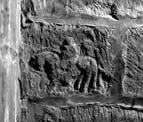
The unframed fragment shows a rider on horseback facing left, the animal with its head down and traces of a rein across its neck. The beast has four legs and a long tail; beneath its belly are forms which could be traces of the rider's legs or saddle cloth. The man appears to carry a round shield (though in certain lights it appears to be kite-shaped) and there might be traces of a spear above the horse's neck. There are further traces of ornament above and behind the beast's rump. Traces of blue paint can be seen on the rear of the horse and at shoulder level on the man.
Appendix A item (stones dating from Saxo-Norman overlap period or of uncertain date)
Robinson (2004) has argued that the animal has four rear legs and could thus be a representation of Sleipnir, the eight-legged horse of Odin. If so, it would be the only such representation of the multi-legged beast in English sculpture, though there are examples from the early Viking period on Gotland at Alskog Tjängvide and Ardre — together with a less certain example at Lärbro Tängelgårda (Wilson and Klindt-Jensen 1966, fig. 42, pl. XXVI; Lindqvist 1941–2, i, Taf. 31, fig. 86). The tradition of the eight-legged horse, the offspring of Loki, is recorded in Snorri and in one of Gestumblindi's fables (Turville-Petre 1964, 56). There is however no reason to assume that this Shocklach carving shows anything other than a conventional quadruped: the features in the area beneath the animal's belly (which provides some of the extra limbs for the 'Sleipnir' interpretation) do not reach the ground like the rear or front legs and are more likely to represent the rider's legs or a saddle cloth; comparison with various Scottish horsemen strengthens this interpretation (e.g. Allen and Anderson 1903, iii, figs. 217B, 260B, 313B, 334, 426, 471A, 479C, 487).
The ornament to the right and above the beast could be resolved into a bird standing on the horse's rump together with a man following on foot. If so, then the scene might have been intended to depict the secular aristocratic pastime of hunting (Åkerström-Hougen 1981; Oggins 1981). If the bird were held behind the rider's back then one might compare the rider on Prestbury 1D and, more certainly, on the Klinte, Gotland stone (Ill. 237; Åkerström-Hougen 1981, fig. 8).
Given the worn nature of the carving, much is inevitably speculation. But it should be noted that there is no clear contextual or stylistic indication that this carving is of pre-Norman date; indeed if the shield is kite-shaped then it would certainly be post-Conquest.
