Select a site alphabetically from the choices shown in the box below. Alternatively, browse sculptural examples using the Forward/Back buttons.
Chapters for this volume, along with copies of original in-text images, are available here.


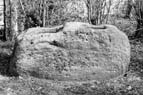
Object type: Double socket-stone
Measurements:
H. 81 cm (32 in); L. 158 cm (62 in); W. 41 cm (16 in)
Sockets: north 32 x 24 cm (12.5 x 9.5 in), 22 cm (8.5 in) deep; south 36 x 24 cm (14 x 9.5 in), 18 cm (7 in) deep
Stone type: Yellowish grey (5Y 7/2), bedded, medium-grained, clast-supported, quartz sandstone, with a few scattered feldspar clasts (one up to 2.5 mm). Grain size ranges from 0.3 to 2.5 mm, but most grains are in the range 0.5 to 1.0 mm; a few scattered pebbles up to 8 mm. ?Helsby Sandstone Formation, Sherwood Sandstone Group, Triassic
Plate numbers in printed volume: Ills. 649-50
Corpus volume reference: Vol 9 p. 239
(There may be more views or larger images available for this item. Click on the thumbnail image to view.)
The roughly-squared stone carries two rectangular sockets, now set at slightly different levels. The higher socket has a raised rim around it.
Double socket-stones have a limited distribution across the borderlands of Cheshire, Lancashire, Derbyshire and Yorkshire (see Chapter V, pp. 37–8). Like the double sockets at Haslingden 1 and Whalley 14 this stone was designed for rectangular shafts (Ills. 506–7, 706–7). As with several such sockets it does not appear to have been originally associated with a church site. Indeed a nineteenth-century tradition suggests that it had a territorial function, threatening that the Trafford family would lose their estates if this stone were moved (Crofton 1903, 45).
Crofton (ibid., 46) adds that in 1873 old persons remembered a similar base at both Cheetham Hill and Rochdale (Harland and Wilkinson 1873, 54).
