Select a site alphabetically from the choices shown in the box below. Alternatively, browse sculptural examples using the Forward/Back buttons.
Chapters for this volume, along with copies of original in-text images, are available here.


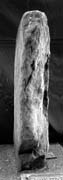
Object type: (7) Part of coped slab [1] [2] [3]
Measurements: L. 79 cm (31 in); W. 41 cm (16 in); D. 11 > 9 cm (4.25 > 3.5 in)
Stone type: As Sandbach (St Mary) 2
Plate numbers in printed volume: Ills. 309-12
Corpus volume reference: Vol 9 p. 125
(There may be more views or larger images available for this item. Click on the thumbnail image to view.)
The stone is described as a recumbent monument but with compass points reflecting its present vertical positioning.
A (broad, top; west): The decoration on this coped face is bounded by an outer cable moulding and an inner plain frame. A plain central moulding runs up the length of the stone separating the ornament into pairs of arched frames which spring from the inner frame; only two such pairs survive, the arch of the lower forming the curved base of the upper. In both instances most of the left-hand panel has been cut away. (i) Above the (present) top of the surviving right-hand upper arch is a pellet to the right and a mask to the left. Within the panel is a human figure, forward-facing with pear-shaped head and hunched shoulders; eyes and ears are well marked. The short arms, with knob-like hands, cross in front of the (non-existent) body; the body is formed by two looping strands of interlace which meet to form a triquetra at the bottom of the panel. (ii) In the panel below are two figures, seen in profile, facing in towards each other. They are seated on a circular cushion with legs tucked in below. The arms are bent sharply across the waist and they possibly hold short staffs in front of them. The double-outlined profile heads have jutting chins (see Chapter IV, p. 23).
B (narrow, side; south): Two parallel incised lines run the length of the stone.
C (broad, base; east): No decoration
D (narrow, side; north): Cut away
The general organisation and dimensions of the arches match those of Sandbach (St Mary) 4, and it is designed to be read in the same manner from the narrow end of the monument. With Sandbach (St Mary) 4 also it shares the same combination of cable moulding and inner frame which recur on the Sandbach Market Square crosses. It is likely therefore that the two formed parts of the same monument.
Several details can be matched on the Market Square crosses: pellet infills; double-outlined profile heads; arms bent across the body holding short staffs. In addition Market Square 2 has small masks in the frame which are used in the same way as the example here in the spandrel of the arch. The Market Square shafts do not, however, have examples of two figures sharing the same arched panel.
The distinctive feature of this carving is its use of interlace/triquetra in place of a body, the familiar Sandbach triangular head being flanked by humped shoulders which are linked to straight arms terminating in swollen ends. Such 'interlace men' are found in both Derbyshire and Staffordshire (Browne 1887c; Pape 1946–7; Kendrick 1949, pl. XLVII), though the particular form adopted here, with lowered arms and no dress or feet, is not paralleled in any of the other surviving examples. It may be, however, that Sandbach Market Square 2 provided a local inspiration for this piece of playfulness, because it has masks set in its borders which are placed over interlace (see Ills. 287, 292; Hawkes 2002, figs. 3.8, 3.9, 3.11, 3.17). If so, then its spread into Staffordshire and Derbyshire is a further example of the impact of the Sandbach carvings on regional sculpture.
The identity of the two seated figures is inevitably problematic given the worn nature of the carving. It is just possible that this is a version of the meeting of St Paul and St Anthony (see Ó Carragáin 1988; Harbison 1992, i, 304–6; Henderson, I. 2001, 120–9 for Insular versions of the theme). This scene characteristically shows two seated and facing figures, occasionally holding short rods or sceptres; the panels at St Vigean's 7, Arboe and Kells provide close parallels (Henderson and Henderson 2004, ill. 204; Harbison 1992, iii, figs. 735, 951). Yet in those cases there are, admittedly, additional elements in the scenes which point to this identification: raven, bread, palm tree — none of which are certainly present at Sandbach. It is perhaps best grouped with the anonymous seated figures at Ullard and Tynan, on which Harbison commented that they 'would fit into the Paul and Anthony iconography' (Harbison 1992, i, 304, ii, figs. 640, 644).
[1] The following is a general reference to the Sandbach St Mary stones: Higham, N. 1993b, 167–9.
[2] Numbers in bracketed italics are those given by Radford (1957) and Hawkes (2002), and used in the present display. The following is an unpublished manuscript reference to no. 5: BL Add. MS 37547, item 725 (Romilly Allen collection).
[3] The following is an unpublished manuscript reference to no. 5: BL Add. MS 37547, item 725 (Romilly Allen collection).
