Select a site alphabetically from the choices shown in the box below. Alternatively, browse sculptural examples using the Forward/Back buttons.
Chapters for this volume, along with copies of original in-text images, are available here.


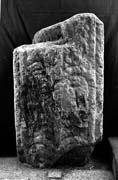
Object type: (6) Part of coped slab [1][2]
Measurements: L. 89 cm (35 in); W. 51 > 49 cm (20 > 19.25 in); D. 20 > 14 cm (8 > 5.5 in)
Stone type: As Sandbach (St Mary) 2 but more heavily encrusted
Plate numbers in printed volume: Ills. 305-8
Corpus volume reference: Vol 9 p. 124
(There may be more views or larger images available for this item. Click on the thumbnail image to view.)
The stone is here described as a recumbent monument but with compass points reflecting its present vertical positioning.
A (broad, top; west): This coped face is bordered by an outer cable moulding with a second, plain, inner moulding frame. A central plain moulding runs up the length of the stone dividing the field into three pairs of arched niches which spring from the inner frame and central moulding. Only the central pair of arches is now complete; they are not quite in line with each other. (i) The decoration in the left of the surviving part of the upper pair of panels is now indecipherable, but to the right the panel was filled with some form of interlace. (ii) Of the central pair of panels, no decoration is now visible to the left; to the right the frame contains a backward-turning beast with its head facing to the left at the top of the panel. One front leg hangs to the right whilst above its back is a second leg or, more likely, a foliate tail. Two rear legs cross, frog-like, below the body. The head is in profile with open extended jaws, slightly clubbed at the end. (iii) Only the decoration in the left-hand pair of panels survives below. This consists of a bird-like head seen in profile and facing to the right; its broad neck carries a contoured line.
B (narrow, side; south): The only decoration consists of two parallel lines running down the length of the stone.
C (broad, base; east): No decoration
D (narrow, side; north): No decoration visible.
If this is indeed a coped stone, with face A as the top, then the arched arrangement of motifs would represent a curious horizontal adaptation of a widespread Sandbach scheme, designed to be read from the end of the stone. As such it contrasts with the coped stone at Wirksworth, the roof of the Hedda stone at Peterborough and the Bakewell shrine, whose ornament is all planned to be read from one broad side (Hawkes 1995b; Bailey 2000a, figs. 7, 8; Cramp 1977, fig. 60a; Routh 1937, pls. V, VI, VII). The coping is closer to Wirksworth than to the other gabled Mercian forms just quoted.
There is clearly a close relationship between this slab and the Sandbach Market Square shafts in the combination of cable moulding with narrow inner arched frame. The animal head is also from the same menagerie as those on the east face of Market Square 2 and the south face of Market Square 1 (Ills. 272, 289; Hawkes 2002, figs. 7.3, 6.14, top right); all have the same kind of mouth — a mouth also repeated on the scroll terminals and animals in the nativity scene on Market Square 1 (Ills. 265, 272; Hawkes 2002, figs 6.4, 6.14). The bird form in the lower left has a sharper beak than found on most of the other Sandbach avian forms, though it is close to the eagle on Market Square 1 (Ill. 265; Hawkes 2002, fig. 5.1). Its contoured neck can be paralleled among Mercian sculptures at Derby St Alkmund's, Gloucester, Glatton in Huntingtonshire and Elstow in Bedfordshire (Cramp 1977, figs. 62, 63).
The stone is probably part of the same monument as Sandbach (St Mary) 5 below (Hawkes 2002, 127).
[1] Numbers in bracketed italics are those given by Radford (1957) and Hawkes (2002), and used in the present display.
[2] The following is a general reference to the Sandbach St Mary stones: Higham, N. 1993b, 167–9.
