Select a site alphabetically from the choices shown in the box below. Alternatively, browse sculptural examples using the Forward/Back buttons.
Chapters for this volume, along with copies of original in-text images, are available here.


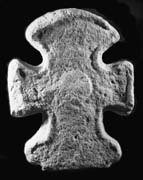
Object type: Cross-head [1]
Measurements: H. 61 cm (24 in); W. 46 cm (18 in); D. 14 cm (5.5 in)
Stone type: Greyish orange-pink (5YR 7/2), bedded, clast-supported, medium-grained sandstone. Bedding is parallel to the worked face. The size of the sub-rounded grains varies according to individual beds from 0.3 to 0.5 mm in one layer, to 0.4 to 0.6 mm in another layer; a few grains are up to 1.0 mm, with one 5 mm quartzite pebble noted. Most clasts are quartz, but there is a scatter of dark (?ferruginous) patches up to 3.0 mm across. Millstone Grit, Carboniferous
Plate numbers in printed volume: Ills. 645-8
Corpus volume reference: Vol 9 p. 238
(There may be more views or larger images available for this item. Click on the thumbnail image to view.)
Andrew Moore has kindly drawn my attention to articles written by J. Maxim in the Rochdale Observer for 7 and 14 October 1922. These show that the cross-head was presented to the town and Museum by Mrs Cryer in 1919. Maxim also examined the confusing evidence for its earlier history.
One tradition claimed that it had been discovered in the early nineteenth century near Goose Lane (SD 897138) during road making and had then been placed in a garden at Willow Bank by a Mr Lancashire; he had subsequently given it to Samuel Lomax who set it up in the grounds of Castle Hill.
An alternative, or supplementary, account states that the Lord of the Manor, Mr Dearden, gave it to his steward Lomax who in turn presented the carving to his daughter Mrs Cryer. This head has been identified as that of the market cross which Taylor (H. 1906, 457), quoting Fishwick (1889, 557), records as being pulled down in the early nineteenth century and later removed to Goose Lane. Other sources, however, attribute its destruction to vandalism in the 1770s and the equation between the Museum cross-head and the market cross must remain unproven.
Cross-head, type E8, though with wider curve
A (broad): Decoration consists of a border moulding and a much-worn central boss. Dr R. Trench-Jellicoe, who has examined the stone closely under various lights, suggests that there may be residual traces of quadruped animal ornament around the central boss.
B and D (narrow): Undecorated
C (broad): No decoration survives on this heavily worn face.
The 'penannular' form of head is popular on both sides of the Pennines in the tenth and eleventh centuries (see Chapter V, p. 33). If animal ornament was present on face A, then its closest regional parallel is provided by Winwick 1 (Ill. 713); further afield, Winston in Co. Durham carries analogous quadruped forms set around a central boss (Cramp 1984, pl. 147.774).
