Select a site alphabetically from the choices shown in the box below. Alternatively, browse sculptural examples using the Forward/Back buttons.
Chapters for this volume, along with copies of original in-text images, are available here.


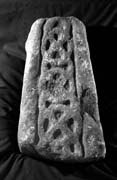
Object type: Part of round-shaft
Measurements: H. 46 cm (18 cm); W. 28 > 17 cm (11 > 6.75 in); D. 21 > 15 cm (8.25 > 6 in)
Stone type: Pale red (5R 6/2) medium- to coarse-grained, clast-supported, quartz sandstone. Clasts 0.3 to 0.8 mm, but mostly 0.4 to 0.7 mm (a few up to 1.0 mm); white ?kaolinised matrix. Millstone Grit Group, Carboniferous
Plate numbers in printed volume: Ills. 239-43
Corpus volume reference: Vol 9 p. 98-9
(There may be more views or larger images available for this item. Click on the thumbnail image to view.)
A (broad): A broad roll-moulding border flanks the single surviving panel; this curves inwards towards the top. To judge by the surviving traces of the lower arm on faces B and D, the shaft panel must have reached into the lower arm of the cross-head. The panel contains a simple two-strand twist with a ring around each crossing, terminating at the bottom in two inward-curling loose ends.
B (narrow): The upper part of this face is undecorated but carries traces of the lower arm. Below, flanked by broad roll-mouldings, is a run of type 2 meander pattern.
C (broad): Part of the border moulding survives in the lower left together with the remains of (now largely obliterated) relief decoration elsewhere.
D (narrow): As on face B there are the remains of the lower arm of the head at the top of this side. Below, flanked by broad border mouldings, is a single panel of relief ornament. Its form is difficult to reconstruct but it may consist of a serpentine beast, running up the shaft, which is seen in profile; an extended front leg at the top of the panel turns into a spiral. Below, there is another stumpy front leg with, to the left, the beast's head which sprouts a lappet which runs above and onto its back. The rear quarters are confused. An alternative reading would see the spiralling rear of a ribbon beast at the top of the panel, two short legs extending to either side of the body and a large head (towards the bottom of the fragment) with open mouth, ?tooth and extended tongue.
This is almost certainly part of the short upper rectangular section of a round-shaft, type g/h and, like many such in Cheshire, it lacks any churchyard provenance (see Chapter V, p. 36). Its membership of this group is signalled by the inward-curving panels on face A — and possibly also on face C. These panels narrow into the lower part of the head whose fragmentary 'springers' can be seen on faces B and D. The shaft can thus be restored as a round-shaft by reference to the examples at Cheadle 1, Disley Lyme Hall 1 and 2, and Leek, Staffordshire (Ills. 71–4, 131–2, 137–8, 139–41, 156–9; Brown, G. 1937, pl. XCVIII). The ornamental scheme combines meander patterns and encircled two-strand plait (with inward-turning loose strands) as on the nearby round-shafts Disley Lyme Hall 1 and Sutton Ridge Hall 1 (Ills. 131, 138, 314–15); both are popular patterns in the Viking period. The presence of animal ornament on this type of cross is unusual; unfortunately its worn remains defy analysis, though a head-lappet on a serpentine form would not be out of place in Jellinge art.
