Select a site alphabetically from the choices shown in the box below. Alternatively, browse sculptural examples using the Forward/Back buttons.
Chapters for this volume, along with copies of original in-text images, are available here.


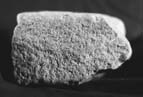
Object type: Part of cross-head
Measurements: H. 18.5 cm (7.25 in); W. 18.5 cm (7.25 in); D. 10.8 cm (4.25 in)
Stone type: Yellowish grey (5Y 7/2), medium grained (0.2 to 0.4 mm), non-calcareous, clast-supported, quartz sandstone; a few fragments of white mica. Bedding parallel to carved face. Grains sub-angular to sub-rounded. ?Coal Measures, Carboniferous
Plate numbers in printed volume: Ills. 631-4
Corpus volume reference: Vol 9 p. 235-6
(There may be more views or larger images available for this item. Click on the thumbnail image to view.)
Hartwell (et al. 2004) described the carving as 'part of wheel-head cross'. The fragment is, in fact, part of the upper or lateral arm of a free-armed cross of type B9 or B10. For description purposes it is here treated as the upper arm.
A (broad): One lateral roll-moulding border and the adjacent end-border survive; within is knotwork using open flat strands. The surviving pattern can be reconstructed as simple pattern F with included U-bend terminals linked by two strands.
B (narrow): No decoration survives.
C (broad): Though slightly less carving survives on this face as compared to A, the border and pattern seem to be identical to those on the other broad face.
D (narrow) and E (top): Plain
This small head seems to have had fairly stumpy arms with broad curves and would restore to the shape of the Irton cross in Cumberland, a form which Cramp argues is 'late in the pre-Conquest series' (Bailey and Cramp 1988, 116, ills. 355–64). Given that there are a number of free-armed crosses in this area during the Viking period, and that the form of cross-head continues into the tenth century, a date in or after the late ninth century would seem probable. The broad flat open plait would perhaps suggest that the tenth, rather than the ninth, century is the more likely period of carving (see Eccles 1, p. 174).
