Select a site alphabetically from the choices shown in the box below. Alternatively, browse sculptural examples using the Forward/Back buttons.
Chapters for this volume, along with copies of original in-text images, are available here.


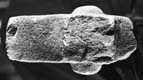
Object type: Part of cross-head [1]
Measurements: H. 20 cm (8 in); W. 30.5 cm (12 in); D. 10 cm (4 in)
Stone type: Light olive grey (5Y 6/1), poorly sorted, clast-supported, quartz sandstone. The sub-angular to sub-rounded clasts range from fine-grained (0.2 mm) to granular (2.5 mm), but are mostly coarse-grained in the range 0.4 to 1.0 mm. Millstone Grit, Carboniferous
Plate numbers in printed volume: Ills. 635-9
Corpus volume reference: Vol 9 p. 236-7
(There may be more views or larger images available for this item. Click on the thumbnail image to view.)
The fragment consists of one complete arm of the transom, together with the centre, of a cross-head of type B9.
A (broad): The decoration is framed by a moulding which follows the moulding outline of the cross but is set in from the edge. At the centre is a bold boss, some 9 cm in radius and raised 3.5 cm high. The boss has marked ribbing. There is no other decoration.
B (narrow): Broken away
C (broad): A channelled line follows the outline of the cross. At the centre is a worn boss, 8 cm in radius and 2 cm high.
D (narrow), E and F (upper and lower): No decoration
Though undecorated, this head resembles several in the area in its use of bold bosses (see Colne 1 and 2, and Whalley 3: Ills. 445, 447–50, 675–8).
