Select a site alphabetically from the choices shown in the box below. Alternatively, browse sculptural examples using the Forward/Back buttons.
Chapters for this volume, along with copies of original in-text images, are available here.


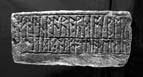
Object type: Fragmentary slab or shrine cover
Measurements: L. 54 > 52 cm (21.2 > 20.5 in); H. 25 > 22 cm (9.75 > 8.75 in); D. 28 > 19 cm (11 > 7.5 in)
Stone type: Pale yellowish brown (10YR 6/2), hard, bedded (cross-bedded?) with bedding parallel to the upper surface, well cemented, fine- to coarse-grained, poorly sorted (most clasts 0.2 to 1.0 mm across, but a few grains up to 2.0 mm), mostly sub-angular, matrix-supported sandstone. One pebble of fine-grained sandstone >5 cm long by 1 cm thick. ?Palaeozoic
Plate numbers in printed volume: Ills. 222-8
Corpus volume reference: Vol 9 p. 91-4
(There may be more views or larger images available for this item. Click on the thumbnail image to view.)
Given the arched nature of the ornament on the surviving narrow end, and the need for the inscription to be read horizontally, it follows that the surviving stone must be identified as part of a deep slab, carved on the top and on (at least) two of its faces, one long side (A) carrying a runic inscription. When viewed from above it is clear that this slab originally had a markedly bombé plan. If this bombé plan were fully completed on the original stone then it would appear that the monument only survives for half of its length. Since the surviving narrow face (D) is nearly complete, it is probable that the height and width of the stone at the end may not have been much greater than now appears.
A (broad): The face carries a runic inscription which is described below.
Inscription On face A two rows of Anglo-Saxon runes are defined by three horizontal framing lines. The first row is notably taller (c. 9 cm) than the second (c. 7 cm). At the left-hand end of the face a vertical framing line can also be traced, though it is partly lost in a patch of surface damage, which has also claimed the opening runes of the second row. At the right-hand end the stone has been cut away, and so both rows are incomplete.
The text reads:
f o l c æ a r æ r d o n b e c [ – ] | [ . . ] b i d d a þ f o t e æ þ e l m u n [ – ]
The great majority of the characters, even where they are slightly damaged or worn, are straightforward to identify. The lower arm of the fifth rune, 'æ', is not entirely clear, but its end is quite visible, and the identification appears certain, even though this causes some difficulty, as discussed below. The lower bow of 'b' at the start of the second row is hard to trace, and so the character looks more like 'w' than the 'b' which is clearly demanded by context: probably the bow has in fact been lost to wear, though cf. the evidently erroneous 'fote' for 'fore', again discussed below. The final visible character, 'n', is broken away but unambiguous.
A peculiarity of the inscription is that the carver has made an attempt, at the beginnings of the rows, to align the runes vertically. Thus, the stave of the third character, 'l', is continued to become the stave of 'b' below it, and likewise the stave of the fourth, 'c', becomes the 'i' of the second row. The arm of the 'c' and the stave of the following 'æ' are directly aligned with the staves of the first 'd' below, though these lines do not join as did the previous ones. Thereafter the patterning is not kept up.
In the light of the arrangement of the third, fourth and fifth runes, it is intriguing to speculate on the layout of the first two, where the opening characters of the second row have been lost. For the staves of both 'f' and 'o' can be seen to cut through the central framing line before they disappear in the damage on the surface, suggesting that the opening characters of row 2 were probably aligned in the same way as the following three. This observation is problematic, however, since the missing runes almost certainly represent a form of the prefix ge- or gi- (see below). A stave continued down from 'o' could perhaps have made up the left-hand side of an 'e', or — perhaps more likely, given that there is no sign of another stave — it may simply have stood alone as 'i' (with, admittedly, a rather large gap to its right if that were the case). But initial 'g', a rune made up of crossed diagonals and no vertical element, could hardly continue from the stave of the 'f' of the first row. It may be, therefore, that the first missing rune was that which is often transliterated 'j', a vertical stave with a small cross in the middle: this rune is used for palatal g — as it would be here — on rune-stones at Thornhill (Coatsworth 2008, 259, no. 2) and Dover St Peter (Tweddle et al. 1995, 143) and it also takes the place of regular 'g' in some other contexts (Parsons 1999, 123–6).
B (end) and C (broad): Lost
D (end): The surviving end-panel is framed above and to the right by a broad flat moulding and there is a further arched frame within that outer border. Inside the arch is the upper part of a very worn beast. The animal faces to the left, has a stubby muzzle and an open mouth from which an elongated tongue emerges to pass diagonally across the body. There are possible traces of a wing on the body near the bottom of the surviving carving.
E (top): Parts of one long and one narrow adjacent sides of the moulding frame survive, along with a small fragment of the border on the other long side. Within these borders is an open-jawed beast, whose body and wing dissolve into interlace. The animal is upside down when read from the inscription side. The beast's head has a foliate ear, bulbous protruding eye and an upper jaw which ends in a vertical bar. The lower jaw ends in a single tooth and a pendant beard. The wing has a round (?spiral) attachment to the body. There are further (now vestigial) forms between the beast and the border moulding: these can be interpreted as leg(s) of the beast or, less plausibly, as a backward-turned quadruped with curled tail.
The substantial but narrow proportions of this stone (even in its present fragmentary state) are unlike other surviving slabs, though in its height it can be matched by the Viking-age slabs at Lowther in Westmorland (Bailey and Cramp 1988, ills. 456–60). The bombé plan is paralleled elsewhere in the Viking period at Haile in Cumberland and Levisham in Yorkshire (Bailey and Cramp 1988, ill. 340; Lang 1991, ill. 648). The stone might have functioned as a grave-cover but the position of its inscription suggests that the carving must have stood clear of the ground; it may therefore have been set on some form of plinth or formed the lid of a more elaborate monument such as a sarcophagus or shrine.
The decorative composition of the top (and the runic inscription) must both have been more extensive than now survives. Collingwood's suggestion that the zoomorphic pattern on face E involved two beasts set tail to interlacing tail is thus perfectly plausible, and his parallel at Otley provides a simplified impression of what probably once ornamented Overchurch (Collingwood 1915, 227; id. 1927a, 126; Coatsworth 2008, ill. 570). The best parallel for this winged beast whose body dissolves into interlace (Ills. 224, 228) is provided by the animals at the base of the west face (C) of Sandbach Market Square 1 (Ill. 268); the analysis of those Sandbach beasts shows that they belong with a Mercian menagerie popular in the period around ad 800 (p. 107). The extremely worn animal on the narrow end-panel, face D (Ill. 227), can be placed in the same artistic world because beasts with turned heads, short muzzles and interlacing tongues are familiar elements in Mercian sculpture of the late eighth and ninth centuries (see Cramp 1977, figs. 62, 63; Tweddle 1992, fig. 581).
InscriptionThe text on the Overchurch stone is of a familiar northern Anglo-Saxon type, a vernacular memorial inscription detailing the sponsor of the monument, the name of the deceased and a request for prayer (the group is discussed in Parsons, D. N. 2008, 79–84). It might be noted that — despite its Mercian artistic parallels (above, and p. 21) — Overchurch is the most southerly representative of a decidedly Northumbrian group of texts, and in this respect it looks north.
In a somewhat corrected and edited form the inscription should probably be read:
In several ways — most interestingly the appearance of a collective folc 'the people' as sponsor — this departs from comparable texts found elsewhere. There is also the question, raised above, of whether the surviving portion could represent only part of the original inscription. And there are a few relatively minor points of detailed interpretation which also require discussion.
To take the textual points first, the opening sequence contains an unexplained rune: the first 'æ' in 'folcæarærdon' is hard to account for. The verb 'arærdon', arærdon 'raised up' (or perhaps 'set up' for a monument interpreted as a slab), is a regular preterite plural form, and an uninflected folc might be construed either as a nominative singular with collective sense, not unnaturally taking a plural verb, or as a regularly developed nominative plural. Folc does sometimes irregularly inflect in the nominative plural, but then it takes the ending appropriate to its neuter gender, and appears as folcu or folco. Thus folcæ, which could regularly only be a dative singular, is hard to account for as the subject of the verb.1 Since there is no indication of word-division in the inscription, it may be that the 'æ' belongs instead with the verb, but æarærdon is also anomalous. Another possibility that has been suggested is that the 'æ' was a first attempt at the correct 'a', abandoned because its lower arm became damaged (Dickins 1932, 19). Whatever the true explanation of this 'æ', it is notable that there is one clear error in the inscription: the carver has cut 'fote', where fore is required. It is difficult to explain 't' for 'r' as anything other than carelessness, and so that must also be conceivable elsewhere in the text.
The first line ends 'bec [ – ]', clearly a form of the common becun 'monument, beacon'. Becun is the most common spelling in vernacular inscriptions, but a variant such as becn, becon or becen cannot be ruled out. As noted above, the missing runes at the opening of the second line presumably comprised a form of the prefix ge- or gi- : although biddan (fore) 'to pray for' is recorded in Old English texts, the prefixed gebiddan (fore) is universally found in the comparable Anglo-Saxon memorial inscriptions. If the argument from the layout, above, is valid, the full form on this stone may perhaps have been 'j i b i d d a þ'.
Comparable inscriptions often simply use gebiddan + dative, but there is a parallel for the use of the preposition fore on Lancaster St Mary 1, and possibly on a stone from Whithorn (Parsons, D. N. 2008, 81). The usage is perhaps calqued on Latin ora(te) pro, and it is notable that two Anglo-Saxon non-runic inscriptions from the vicinity — Lancaster St Mary 2 and Lancaster Vicarage Field — make use of the Latin formula. In any case, the vernacular expression is also fairly well attested in Old English manuscripts, both involving fore and the variant for (Healey et al. 2004, s.v.). The preposition, in either form, can be followed by either the accusative or dative, and so the personal name which follows here — clearly a form of the well-attested masculine Æđelmund — might have been an uninflected accusative, or an inflected dative, Æđelmunde (or -mundæ).
The appearance of folc sets this apart from all other Anglo-Saxon memorial inscriptions. It is a word which is used in many contexts in Old English: senses identified by the Dictionary of Old English (Healey et al. 2004) include 'people in general', 'the public', 'the common people', 'the laity (contrasted with clergy)', 'subjects (of a ruler, temporal or divine)', 'people of a nation, province or city', 'army' and 'band of men'. There is recurrent collocation with terms indicating 'Christian people', and more limited evidence for 'congregation'. The precise sense it should have here, and hence the context in which the memorial was created, is unknown. Elliott suggested that 'it is clearly a memorial to a fallen leader (the word folc suggests this)' (1959b, 145), and speculated further that Æthelmund would have been 'a brave thane who may have fallen fighting against Scandinavian invaders at the end of the ninth century and who was honoured by his followers with this runic request for prayer' (1959b, 147). The art-historical parallels of c. 800 rather puncture this dramatic reconstruction. Given the inescapable ecclesiastical associations of the great majority of Anglo-Saxon memorial inscriptions, and indeed of sculptured stones in general, an interpretation which keeps close to the concerns of the Church might be most likely: perhaps Æthelmund was a priest whose memorial was sponsored by his lay congregation.
On linguistic grounds nothing can be added to the general attribution of the wider group of memorial stones to the eighth and/or ninth centuries (Parsons, D. N. 2008, 83). The inscription has unstressed vowels of the 'later' type, e.g. e in fore, cf. foræ on Lancaster St Mary 1, though it may possibly have also had an 'early' i in the prefix gi- see above). A mixture of such features is characteristic of the group.
The possibility that there could have been another half to the inscribed face raises unanswerable questions. Although unparalleled in its details, the inscription appears to contain all the usual elements of the vernacular memorial group, with references to sponsor, monument and deceased, and a request to prayer. No suggestion can be made, therefore, as to what might have come before or after. The only possible parallel that comes to mind is the otherwise unique Falstone 2 (Hawkhope) memorial, in which versions of the same commemorative text are placed side by side in runic and roman scripts (Cramp 1984, 172–3).
