Select a site alphabetically from the choices shown in the box below. Alternatively, browse sculptural examples using the Forward/Back buttons.
Chapters for this volume, along with copies of original in-text images, are available here.


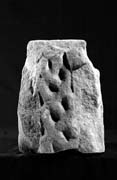
Object type: Part of shaft
Measurements: H. 24.5 cm (9.75 in); W. 18 > 16 cm (7 > 6.25 in); D. 15 > 12 cm (6 > 5 in)
Stone type: Pale red (10R 6/2), fine- to coarse-grained (0.2 to 1.0 mm, but mostly between 0.4 and 0.6 mm), sub-angular to sub-rounded, clast-supported, quartz sandstone. One clast of angular, very dark brown, medium-grained sandstone 1 cm across; one sub-rounded quartz pebble 3 mm across. Helsby Sandstone Formation?, Sherwood Sandstone Group, Triassic
Plate numbers in printed volume: Ills. 218-21
Corpus volume reference: Vol 9 p. 90-1
(There may be more views or larger images available for this item. Click on the thumbnail image to view.)
A (broad): A three-strand plait, narrowing slightly towards the top, is set within broad, heavily abraded, lateral border mouldings. In the upper right corner is a raised flat boss.
B (narrow): The upper part is cut away; below, flanked by a broad moulding to the right and fragmentary border to the left, are traces of a sharply-turned strand of meander pattern or interlace.
C (broad): To the right is a broad flat-moulding border; to the left is another border which narrows markedly to the top of the stone. At the bottom of the surviving decoration is a scroll volute enclosing a triple leaf with scooped centres. This appears to link above to a four-strand plait.
D (narrow): The upper part of this face is blank. Below is a left-hand border flanking worn relief ornament consisting of either serpentine animals or a broad-strand plait.
E (top): The top of the fragment possibly preserves traces of a mortise hole.
The fragment is probably the upper part of a shaft, with mortise hole for the head above. The prominent flat boss (Ill. 218) is difficult to explain. It may represent a 'neck boss' of the type seen on Chester St John 4 and 5 (Ills. 89–92, 95–8). Alternatively, and more likely in view of its geographical proximity, it reflects the metallic-looking bosses attached to mouldings and borders on the Sandbach crosses: see Sandbach Market Square 2D for boss on border, 2A for boss in angle of moulding and no. 1 passim for scattered bosses (Ills. 264, 266, 285, 288–90; Chapter IV, pp. 25–6). Like Sandbach also, and an associated stone from Bakewell, Derbyshire (Ills. 257, 271; Hawkes 2002, 87, fig. 2.31), scroll forms are here linked to interlace (Ill. 220). As discussed below in the examination of Sandbach Market Square 1 (pp. 106–7), this is not a common ornamental device in Mercian sculpture and further confirms the suggestion that the Over stone betrays the impact of the large crosses at Sandbach. Both Sandbach and Over are carved from stone which is not native to the immediate area (see Chapter III, p. 16).
A dating to the later ninth century would thus seem likely.
