Select a site alphabetically from the choices shown in the box below. Alternatively, browse sculptural examples using the Forward/Back buttons.
Chapters for this volume, along with copies of original in-text images, are available here.


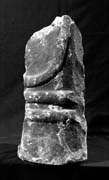
Object type: Part of round-shaft [1]
Measurements: H. 52 cm (20.5 in); W. 17 cm (6.75 in); D. 7 cm (2.75 in); Surviving arc of circumference 24 cm (9.5 in)
Stone type: Pale yellowish grey (5Y/R 7/2), fine- to coarse-grained (0.2 mm to 0.9 mm), but mostly medium-grained in the range 0.4 to 0.5 mm; angular to sub-angular (some grains sub-rounded), clast-supported, quartz sandstone. Millstone Grit Group, Carboniferous
Plate numbers in printed volume: Ills. 185-8
Corpus volume reference: Vol 9 p. 83-4
(There may be more views or larger images available for this item. Click on the thumbnail image to view.)
The surviving fragment represents part of a shaft of type g/h with cylindrical and rectangular sections. Around the cylinder are two horizontal mouldings. Above, on the rectangular section, is a common border moulding between the two fragmentary surviving faces; this splits on both faces to form a swag base to the panels. No decoration is visible within these panels.
Round-shaft (see Chapter V, p. 33). Along with Astbury 1 (p. 47) and Macclesfield 4 below this is the only such carving in the Cheshire group to have a clear ecclesiastical provenance. Its combination of undecorated panels and double encircling mouldings is repeated at Adlington 2, Wincle Cleulow 1 and Wincle Grange 1, and at both Whitfield and Fernilee Hall in Derbyshire (Ills. 2–8, 362–5, 366–71; Sharpe 2002, 95, 98).
