Select a site alphabetically from the choices shown in the box below. Alternatively, browse sculptural examples using the Forward/Back buttons.
Chapters for this volume, along with copies of original in-text images, are available here.


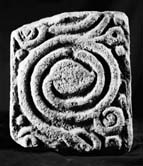
Object type: Part of shaft [1] [2]
Measurements: H. 33 cm (13 in); W. 29 > 28 cm (11.5 > 11 in); D. 24 > 20 cm (9.5 > 8 in)
Stone type: Moderate yellowish brown (10YR 5/4) poorly sorted, clast-supported, quartz sandstone. The sub-angular to sub-rounded clasts range from 0.2 to 1.5 mm, but are mostly medium-grained in the range 0.3 to 0.4 mm. Millstone Grit, Carboniferous
Plate numbers in printed volume: Ills. 596-9
Corpus volume reference: Vol 9 p. 227-8
(There may be more views or larger images available for this item. Click on the thumbnail image to view.)
The surviving face carries traces of a roll-moulding border to the left. One complete spiral of a single-stemmed scroll survives with traces of the adjacent scroll-spirals above and below. At the centre of the spiral is a large heart-shaped leaf whilst the spiral produces a spiralling offshoot in the lower right corner. At the point where the stem and offshoot part there is a scooped pellet on the end of a stiff stalk and there are other loose pellets set around the composition.
The tightly-wound scroll is typical of material from the Lune valley, and other details of this scroll are familiar in the area: (a) the scooped pellet (see e.g. Halton St Wilfrid 6, Heysham 1, Lancaster St Mary 3, Lancaster Vicarage Field 1, and Heversham); (b) loose pellets (Gressingham 1 etc.); (c) curling offshoots (Lowther, Heversham). Single-stem spiral scrolls terminating in a large central leaf, however, are not known elsewhere among Lune valley carvings, but do occur at Ilkley in Yorkshire and Wycliffe on the Tees (Coatsworth 2008, ill. 358; Lang 2001, ill. 1110).
[1]Though all the Lancaster sculptures may have originated at the priory church site, the carvings are here divided into three groups which reflect their find spot. See also Capernwray Hall 1 (p. 169).
[2] The following are general references to the Lancaster stones: Taylor, H. 1898, 42; Farrer and Brownbill 1914, 3, 22; Fellows-Jensen 1985, 273, 402, 405; Higham, N. 2004a, 27, 167, 206; Blair 2005, 216, 309; Salter 2005, 49.
The following are unpublished manuscript references: BL Add. MS 37550, items 666–98, 734 (Romilly Allen collection).
