Select a site alphabetically from the choices shown in the box below. Alternatively, browse sculptural examples using the Forward/Back buttons.
Chapters for this volume, along with copies of original in-text images, are available here.


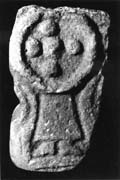
Object type: Part of cross-head [1] [2]
Measurements: H. 35.5 cm (14 in); W. 20.5 cm (8 in); D. 14 cm (5.5 in)
Stone type: Local buff freestone' (Collingwood 1903b, 262)
Plate numbers in printed volume: Ills. 600-1
Corpus volume reference: Vol 9 p. 228-9
(There may be more views or larger images available for this item. Click on the thumbnail image to view.)
The fragment formed the lower arm and upper shaft of a cross, the curve for the lower armpits surviving on both broad faces; possibly of type A10/11.
A (broad): A roll moulding surrounded the cross-head and probably extended down the shaft — traces are visible to the left and, fragmentarily, to the right. Within this frame the head had an additional inner border. At the centre of the cross-head is a circular relief moulding containing five small bosses, set slightly off-centre, which form a cruciform shape. This motif overlies a flat-carved human figure — his head presumably in the now-lost upper arm — whose long flared dress and feet (turned to left and right) remain within the lower arm. Traces of his outstretched arms are visible beyond the circle to the right. There are traces of relief decoration immediately below the inner border moulding underneath the figure's feet.
B (narrow): No decoration
C (broad): A flat boss (? possibly ring-encircled) at the centre of the head was set over a flat-carved human figure whose lower body survives, clad in a kirtle. The figure's surviving left foot is set pointed to the spectator's right. A border moulding survives to the right. Relief decoration is visible below the figure's feet; Collingwood (1903b, 262) interpreted these remains as pincers but they could equally represent the curving termination of knotwork or even some form of knotted snake.
D (narrow): Lost
If correctly restored by Collingwood (1927a, fig. 148), the form of the head is one which matched that of Lancaster St Mary 1 (Ills. 562, 564). Other restorations are, however, perfectly possible.
Crucifixion depictions in which the figure is confined to the cross-head are particularly prevalent in north Yorkshire where they have been seen as a contribution from Irish iconography in the Viking period; the area of the Wicklow Hills near Dublin has been identified as the centre of such Irish parallels (Lang 2001, 36–8). This might imply a similar date for the Lancaster piece.
The decoration on face A combines two forms of ornament which are normally kept distinct: a circle in the middle of the cross-head enclosing five bosses, and a depiction of the Crucifixion.
An encircled group of five bosses forming a cross and placed in the middle of the head occurs at Irton in Cumberland; less significantly arranged, the same numerical number is found encircled on carvings in the same position at Northallerton in Yorkshire and Winston in Co. Durham (Bailey and Cramp 1988, ill. 359; Lang 2001, ills. 672, 673; Cramp 1984, pl. 147.772). In a different form an identical total of bosses also occurs on other cross-heads in the region, as well as on a slab from Dunfallandy, Perthshire, and on the St Ninian's Isle chape inscribed 'in the name of God, the highest' (Henderson, I. 1993, 215, pl. 26.2; Small et al. 1973, pl. XXIX; see Cheadle 1, p. 61). In the visionary Anglo-Saxon poem, The Dream of the Rood, five jewels are described as set on the eaxlegespanne of the cross in a context which clearly identifies them with the five wounds of Christ; a similar significance can reasonably be attached to these sculptural clusters particularly when, as here at Lancaster, the group is laid on top of the crucified Christ (in general see Richardson, H. 1984a).
There are, however, other potential dimensions to this motif. The encircled cross of bosses may also carry Eucharistic symbolism, dependent on patristic interpretations of the gospel narrative of the miracle of the five loaves and two fishes (see Hornby 1, p. 212). This possibility that Christ's sacrifice and its Eucharistic commemoration are simultaneously present in the Lancaster composition becomes all the more compelling when we see the same association being exploited in the depiction of the five loaves at Clonca, Co. Donegal, which are arranged in a cruciform shape (Harbison 1992, iii, fig. 839).
One other potential meaning for this encircled feature needs to be added. This is best approached by reference to a cross-head from Brigham in Cumberland where there is a different kind of association of encircled bosses and a form of crucifixion (Bailey and Cramp 1988, ill. 147; see also Bromborough 5 above, p. 55). Here, in a Viking-age context, the crucified Christ is represented by a head placed over an encircled boss motif; the rest of the body is not shown. Discussion of Brigham has linked it to a series of Irish (and one Manx) crucifixions isolated by Roe (1960) which, among other characteristics, featured a central 'breastplate' set over Christ's body. The Calf of Man slab and Hovstad mounts show this in circular form (Roe 1960, pl. 7 and fig. 4) whilst on the Rinnagan plaque and elsewhere there are variant shapes (Youngs 1989, no. 133). Roe argued that this element alluded to the concept of Christ as High Priest of the New Covenant — a complex of ideas based on the prophetic passage in Psalm XIV ('Thou art a priest for ever after the order of Melchisadech') which was developed in Hebrews VI, VII and IX, and then further treated by Augustine, Ambrose, Prudentius, Sedulius and Venantius Fortunatus. It is possible that this Lancaster motif carried a similar meaning.
Face C of the cross-head is now sadly worn but it is likely that this depicted some form of Christ in Majesty as a balance to the Crucifixion. In that case the total scheme may have consisted of a triumphant warrior Christ, holding a round shield (neatly balancing the central motif on the other side), and treading down a serpentine rendering of the asp and basilisk of Psalm XCI, 13.
In summary, though badly battered, this Lancaster carving carried a richly theological statement of the suffering, triumph and eternal priesthood of Christ.
[1]Though all the Lancaster sculptures may have originated at the priory church site, the carvings are here divided into three groups which reflect their find spot. See also Capernwray Hall 1 (p. 169).
[2] The following are general references to the Lancaster stones: Taylor, H. 1898, 42; Farrer and Brownbill 1914, 3, 22; Fellows-Jensen 1985, 273, 402, 405; Higham, N. 2004a, 27, 167, 206; Blair 2005, 216, 309; Salter 2005, 49.
The following are unpublished manuscript references: BL Add. MS 37550, items 666–98, 734 (Romilly Allen collection).
