Select a site alphabetically from the choices shown in the box below. Alternatively, browse sculptural examples using the Forward/Back buttons.
Chapters for this volume, along with copies of original in-text images, are available here.


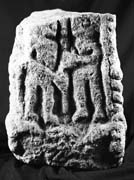
Object type: Part of shaft [1] [2]
Measurements: H. 41 cm (16 in); W. 28 > 25.5 cm (11 > 10 in); D. 25 > 22.75 cm (9.75 > 8.5 in)
Stone type: Greyish orange (10YR 7/4), poorly sorted, clast-supported, quartz sandstone. The sub-rounded clasts range from fine-grained (0.2 mm) to granular (2.5 mm), but are mostly medium- to coarse-grained in the range 0.4 to 0.8 mm; fragments of white feldspar. Millstone Grit, Carboniferous
Plate numbers in printed volume: Ills. 592-5
Corpus volume reference: Vol 9 p. 226-7
(There may be more views or larger images available for this item. Click on the thumbnail image to view.)
All four remaining faces of this rapidly-tapering fragment carry a single panel of ornament, flanked laterally by an narrow inner moulding and an outer cable moulding. Clearly visible on the narrow faces, and intermittently also on the broader sides, is a zigzag moulding running continuously around the shaft at the base of the surviving panels. Collingwood recorded the presence of red paint on this carving.
A (broad): The ornament consists of two human figures set on either side of a vertical stem which they clasp with their one visible hand; they are seen in profile, naked or wearing short skirts with feet turned inwards. The right-hand figure may be portrayed with a large round eye but otherwise no facial features survive.
B (narrow): This panel contains a central vertical moulding round which is twisted a serpentine form, with curled tail, whose head is set in the bottom right corner of the panel. It has open jaws, the upper one curled, and an eye set in a marked forehead. At the top to the left of the vertical stem there are abraded traces of a spiral form, whilst to the right there is a serpent head seen from above with flat snout and two large bulbous eyes. Below the encircling zigzag moulding there are further relief shapes in the right corner.
C (broad): This face is occupied by two figures standing on broad uneven ground above the encircling zigzag moulding. To the left is a small figure, naked or wearing a short kirtle, forward-facing with the two eyes well marked; there are traces of a cowl, halo or hair at the neck. Both feet face right and his single hand passes across his chest to grasp a vertical stem which rises to the top of the surviving panel. To the right of the stem, his feet at a slightly higher level, are the legs and torso of a taller second figure; his feet face to right and left. He appears to be naked (?and even phallic).
D (narrow): This damaged face shows zoomorphic heads terminating broad flat serpentine bodies which run parallel to each other down the upper part of the surviving section of the shaft. To the right is a collared snake-like form, the head seen from above, whose bulging eyes are set above a pointed snout; this terminates the right-hand body, after curling round the left-hand snake. To the left, and facing to the left, is a collared beast with open jaws and round eye.
Given the fragmentary nature of what has survived the interpretation of the scenes depicted here is inevitably far from clear. Face C is perhaps the most certain. Collingwood (1903b, 266) saw it as a crucifixion with the single figure of Longinus holding his spear. As he drew it, the spear-shaft was markedly bent towards the larger figure but he argued that this could be paralleled on other crucifixions. Yet the shaft is not bent inwards — and the only element which carries an angular bend in Insular crucifixions is the cup (e.g. Bourke 1993, 176–7). Furthermore, and more tellingly, a single flanking figure would be highly unusual in a crucifixion scene. Other possibilities should therefore be canvassed.
Among these is Delilah cutting Samson's hair, a scene which Isabel Henderson identified among the 'dregs of a Samson cycle' at Inchbrayock, Angus (Allen and Anderson 1903, iii, fig. 235a; Henderson, I. 1967, 145–7; Henderson and Henderson 2004, 143). This, in its Pictish realisation, has the necessary combination of tall and short figures with a long element of hair held between the two. Yet this is such a rare scene — and there is no sign of the expected shears — that we can perhaps dismiss it here.
More convincing is an identification of the figures as David and Goliath. This is a scene which is very well evidenced in a variety of forms on Irish crosses and in English sculpture and manuscripts (Harbison 1992, i, 217–20, iii, figs. 733–41; Hourihane 2002, 127–52; see also Neston 2, p. 87). This explanation would account for the disparity in height between the two figures, which is evidenced elsewhere by a panel on the south cross at Castledermot and scenes in the Corbie Psalter and BL MS Harley 603 (Harbison 1992, iii, fig. 733; Hubert et al. 1969, pl. 206; Haney 1986, pl. 73). It would also explain the tall shaft set between them: an extremely long spear is a striking feature of the scene at Newent in Gloucestershire and in Harley 603 whilst a long staff is present on the depictions on the Arboe cross and in Cambridge St John's College MS C. 9 (Harbison 1992, iii, fig. 740; Haney 1986, pl. 73; Alexander 1978, ill. 352). The episode was early established as a type of salvation, symbolic of Christ's victory over Satan and the conquest of evil (Grabar 1972, ii, 10, 308; Hawkes 2005, 265–6).
Collingwood (1903b, 266) identified the scene on face A as Adam and Eve, 'clearly discriminated', on either side of the tree of knowledge. That discrimination is not now convincingly present. Though his interpretation remains a possibility, one might have expected some indication of snake, apple offering, or awareness of nakedness in a depiction which is unlikely to be part of a lengthy narrative cycle. This may therefore be a scene showing figures grasping the base of a cross of the type listed under Halton St Wilfrid 1 (p. 180).
The serpentine heads on faces B and D are typical of Viking-age zoomorphic types. Good parallels for snake-heads with bulbous eyes, seen from above, are provided by Manx crosses, Yorkshire sculptures like Birkby 1 and Gilling West 2, or the shaft at Alstonefield in Staffordshire (Kermode 1907, nos. 95, 97; Pape 1945–6, 22; Lang 2001, 114, ills. 22, 267). Similarly the head with curled nostril in the lower right corner of face B can be matched at Beckermet St John 4 in Cumberland and is, indeed, of a kind with the head on Lancaster St Mary 1 (Ills. 562, 566; Bailey and Cramp 1988, ill. 68).
The cable moulding is a feature of both Anglian and Viking-age carvings in the Lune valley (see Heysham 1 and Halton St Wilfrid: Ills. 465–70, 483, 490, 509–11, 514) but the horizontal zigzag moulding is not paralleled locally; it may be a playful version of the collar surrounding many round-shafted and round-shaft derivative crosses.
[1]Though all the Lancaster sculptures may have originated at the priory church site, the carvings are here divided into three groups which reflect their find spot. See also Capernwray Hall 1 (p. 169).
[2] The following are general references to the Lancaster stones: Taylor, H. 1898, 42; Farrer and Brownbill 1914, 3, 22; Fellows-Jensen 1985, 273, 402, 405; Higham, N. 2004a, 27, 167, 206; Blair 2005, 216, 309; Salter 2005, 49.
The following are unpublished manuscript references: BL Add. MS 37550, items 666–98, 734 (Romilly Allen collection).
