Select a site alphabetically from the choices shown in the box below. Alternatively, browse sculptural examples using the Forward/Back buttons.
Chapters for this volume, along with copies of original in-text images, are available here.


Object type: Part of shaft [1] [2]
Measurements: H. 60 cm (23.5 in); W. 20 cm (8 in); D. 15 cm (6 in)
Stone type: Not examined; 'local freestone' (Collingwood 1903b, 259)
Plate numbers in printed volume: Ills. 587-91
Corpus volume reference: Vol 9 p. 225-6
(There may be more views or larger images available for this item. Click on the thumbnail image to view.)
A (broad): The fragment carries a double/parallel-stemmed scroll flanked laterally by a double roll-moulding border. Three spiralling offshoots are visible. At the base to the left is a worn spiral which terminated in a round leaf; the spiral throws off a pointed veined leaf above. To the right, and above, a side-shoot splits from one of the main stems and runs parallel with it before curling away into a spiral terminating in a four-berry fruit cluster; that spiral throws off a veined split leaf (or half-moon leaf) which lies above it. To the left, in the upper corner of the surviving fragment, the other main stem splits, the side shoot running parallel before curling away to terminate in a trilobate fruit cluster; a (now worn) pointed veined leaf hangs from this spiral.
B (narrow): Interlace of simple pattern F, with long glides, flanked laterally by a double roll-moulding border. The loops are slightly squared.
C (broad): This face carries a double/parallel stemmed scroll of similar type to that on face A, with traces of a double roll-moulding border. Two spirals remain. At the bottom the side shoot runs parallel to the main stems before curling away to terminate in a trilobed fruit cluster. There is a triangular dropped leaf suspended from this spiral. The other main stem splits in the upper left corner of the surviving fragment, the side stem running parallel to the main stem before curling away to end in a trilobed fruit cluster. There is another split leaf/half-moon leaf above, whilst a serrated triangular leaf is suspended from the spiral.
D (narrow): As face B, flanked laterally and below by a double roll-moulding border.
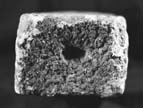
E (top): There are traces of a mortise hole at the top of the fragment.
The mortise hole may represent the point at which the shaft was joined to the head; if so, given the incomplete nature of the top of the panels, the mortise must have been relatively deep. Alternatively the shaft itself may have been in two pieces, tenoned to each other like several Yorkshire carvings (Lang 1991, ills. 764–71; id. 2001, ills. 172, 179, 887–8).
In many ways this shaft fits into general pattern of Lune valley scroll shafts. This is certainly true of its foliate forms (see Chapter IV, p. 20) and its use of the 'western split-stemmed' form of scroll (see Chapter IV, pp. 20–1, Fig. 11). Within the group it is most closely related to Halton Green 1 in combining (presumably) full-length scrolls with knotwork ornament; the Halton shaft may even have carried the same type of interlace pattern (Ills. 504–5). In other respects it plays interesting variations on familiar Lune valley tunes, including a doubling of the main stem. Unlike most within this area, both broad and narrow faces have double-moulding borders — as did the earlier and more ambitious shafts within the group at Lowther and Heversham (Bailey and Cramp 1988, ills. 351–4, 436–9).
[1]Though all the Lancaster sculptures may have originated at the priory church site, the carvings are here divided into three groups which reflect their find spot. See also Capernwray Hall 1 (p. 169).
[2] The following are general references to the Lancaster stones: Taylor, H. 1898, 42; Farrer and Brownbill 1914, 3, 22; Fellows-Jensen 1985, 273, 402, 405; Higham, N. 2004a, 27, 167, 206; Blair 2005, 216, 309; Salter 2005, 49.
The following are unpublished manuscript references: BL Add. MS 37550, items 666–98, 734 (Romilly Allen collection).
