Select a site alphabetically from the choices shown in the box below. Alternatively, browse sculptural examples using the Forward/Back buttons.
Chapters for this volume, along with copies of original in-text images, are available here.


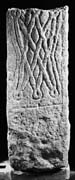
Object type: Part of shaft [1] [2]
Measurements: H. 74 cm (29.25 in); W. 31 > 28 cm (12.25 > 11 in); D. 26 cm (10.25 in)
Stone type: Pale yellowish brown (10YR 6/2), poorly sorted, clast-supported, quartz sandstone. The sub-angular to sub-rounded clasts range from medium-grained (0.3 mm) to pebbly (4.0 mm), but are mostly medium- to coarse-grained in the range 0.4 to 1.0 mm. Millstone Grit, Carboniferous
Plate numbers in printed volume: Ills. 584-6
Corpus volume reference: Vol 9 p. 223-5
(There may be more views or larger images available for this item. Click on the thumbnail image to view.)
A (broad): The lower part of the surviving shaft, 30 cm (12 in) high, is undecorated; Collingwood (1903b, 261) argued that this was for a tenon. Flanked by a flat-band moulding border is a single panel containing a straight-line lacing pattern or 'cats cradle' (Cramp 1991, fig. 25, Cvi) with looped terminals. There is an additional outside strand on the left emerging from the undecorated area at the base of the panel.
B (narrow): Cut away
C (broad): The decoration on this face does not completely fill the panel. The 'cat's cradle' ornament is the same as on face A, though without the outside strand.
D (narrow): The lower section of the stone is left undecorated to the same height as face A. Above this, flanked by a flat-band moulding border, is a panel containing a cross-head, with wedge-shaped arms and curved armpits (type B9), standing on a narrow shaft with a single stepped base. Clothed figures, in profile and with feet facing inwards, flank the shaft, their animal or bird-like heads reaching into the lower armpits of the cross. Each beast appears to have an eye, extended jaws and a tongue; Collingwood (1927a, 102) claimed that 'each has a circle on its breast filled with pellets' but this detail cannot now be seen. With its head facing down into the top right quadrant of the cross is a bird, seen from above, with wings folded back against the body; traces of the head of a balancing bird can be seen in the remaining part of the upper left quadrant. The whole carving is very flat.
The scene on face D, showing a cross set on a slender stem with birds above the arms and two flanking figures, is nowhere exactly paralleled in Britain, though all of the elements exist elsewhere in both Insular and European art. Thus birds above an unoccupied cross occur on Anglian slabs at Knells in Cumberland and Wensley in Yorkshire, on tenth- or eleventh-century slabs in Lincolnshire and, in a slightly different form, on the eleventh-century Newent slab in Gloucestershire (Bailey and Cramp 1988, ill. 425; Lang 2001, ill. 883; Everson and Stocker 1999, ills. 187, 231; Zarnecki 1953, pl. 3). In Scotland they can be found on a tenth-century slab at Rothesay, Bute, and at Kilmory Oib, Knapdale (Fisher 2001, 16, 81, fig. 16A). Manx sculpture used a similar motif in Viking-period contexts (Kermode 1907, nos. 93, 97 and 103), whilst there are further occurrences at an earlier date in Ireland (Henry, F. 1965, figs. 15b and c; Harbison 1986, 64). On the continent, there are good examples reaching from fourth-century Roman sarcophagi to Merovingian and Carolingian manuscripts (Rice 1965, 204–5; Schiller 1972, pl. 1).
Though the Lancaster birds thus fit into a well-established tradition, their meaning is uncertain. Henry (F. 1967, 183–4) interpreted them as pure souls; an equation between souls and birds is, of course, a familiar literary notion (see Henry, P. 1966, 137–49; Clemoes 1969, 68–9). Equally, however, they could be symbols of resurrection or carry angelic connotations.
The animal or bird-headed figures flanking the empty cross equally pose problems of interpretation. The discussion of Halton St Wilfrid 1 above listed a series of Viking-age carvings in which figures stand by an empty cross (p. 180), but none of these have animal or bird-like heads. Seemingly closer to the Lancaster iconography is a slab from Kirklevington, Yorkshire, where two figures, one cock-headed, the other goat-headed, face each other across a vertical moulding. Recently, however, Lang has rejected Collingwood's suggestion that this moulding represents the shaft of a cross, and argues that the figures represent some form of St Anthony narrative (Collingwood 1907a, 350; Lang 2001, 143–4, ill. 412). If this is granted, then we have no other animal-headed figures set beneath a cross in England. Only on the Isle of Man is there any seemingly analogous pair of animal-headed figures flanking a cross. These Manx figures, however, are shown as seated and facing outwards, and do not seem to offer any close parallel (Kermode 1907, nos. 62, 63, 64; see also Orchard 1995, 15; Henderson, I. 1997, 19).
Lacking any helpful parallels in a different context, the meaning of these Lancaster beast-headed characters is inevitably uncertain. As discussed below under Winwick 1 however, devils are frequently depicted in Anglo-Saxon art with distorted, animal-like features (p. 258) and this would therefore be an appropriate form in which to depict those assailing a symbolic Crucifixion. In that context animal heads would seem particularly meaningful as a visualisation of the patristic understanding of verse 17 of the Passion Psalm XXI: 'For many dogs have encompassed me; the council of the malignant hath besieged me'. Cassiodorus began his commentary on these lines by drawing attention to their Christological import: Hic mirabili proprietate passionis suae sacramenta describit ('Here He describes the mysteries of His Passion with marvellously apt words'), whilst the late eleventh-century Barberini Psalter illustrated them by depicting Christ flanked by dog-headed men (Marrow 1977, pl. 6). Does this Lancaster carving draw upon these understandings of that well-known passage? Alongside that suggestion, it might be relevant to note that the 'dogs' of Psalm XXI are interpreted by Cassiodorus as Jews (Adriaen 1958, i, 198; Walsh 1990–1, i, 224); Collingwood's record of a boss-filled circle on the breast of each figure could thus represent the jewelled breastplate of a Jewish priest.
Alternatively, given the absence of a crucified figure, we should consider the possibility that the composition alludes to the Old Latin version of the Canticle of Habakkuk, III, 2, sung on Fridays at Lauds and at the ninth hour of Good Friday (Ó Carragáin 2005, 184–5), where it is prophesied of Christ that 'you will be known in the midst of two animals' (in medio duorum animalium innotesceris). In his commentary on this passage Bede, following Jerome and whilst admitting other interpretations, acknowledges that this can be taken as referring to the recognition of Christ at the crucifixion, set between two thieves (Adriaen 1970, 620; Hudson, J. 1983, 383–4; Ward, B. 1993; Connolly 1997, 68). The significance of this passage for interpretation of the crosses at Bewcastle and Ruthwell, as well as Irish and Pictish sculpture, and illumination in the Book of Kells, has been persuasively argued by Ó Carragáin (1986, 383–9; 1987, 19; 1988; 1994; 2005, 207–8). The theme of recognition of Christ, even (indeed especially) in his absence, would here be particularly telling.
Dating this carving is not easy. Collingwood (1927a, 191, index) referred it to the eleventh century, but it would probably be more cautious to attribute it, less narrowly, to the Viking period. The non-modelled carving would best fit this date. So also would the 'cat's cradle' decoration. Admittedly this is found on two other western Northumbrian monuments at Carlisle and Irton in Cumberland in the ninth century (Bailey and Cramp 1988, ills. 208–9, 356, 358), but similar forms are used on Viking-age carvings in Yorkshire at Leeds, and in Allertonshire at sites like Baldersby, Brompton, Kirklevington, Pickhill and Sockburn (Coatsworth 2008, ills. 479, 490; Lang 2001, 46, ills. 7, 42, 48, 401, 736; Cramp 1984, pl. 134.727, 729).
[1]Though all the Lancaster sculptures may have originated at the priory church site, the carvings are here divided into three groups which reflect their find spot. See also Capernwray Hall 1 (p. 169).
[2] The following are general references to the Lancaster stones: Taylor, H. 1898, 42; Farrer and Brownbill 1914, 3, 22; Fellows-Jensen 1985, 273, 402, 405; Higham, N. 2004a, 27, 167, 206; Blair 2005, 216, 309; Salter 2005, 49.
The following are unpublished manuscript references: BL Add. MS 37550, items 666–98, 734 (Romilly Allen collection).
