Select a site alphabetically from the choices shown in the box below. Alternatively, browse sculptural examples using the Forward/Back buttons.
Chapters for this volume, along with copies of original in-text images, are available here.


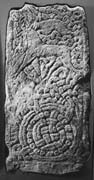
Object type: Part of shaft [1] [2]
Measurements: H. 92 cm (36.25 in); W. 47 > 39 cm (18.5 > 15.25 in); D. 12 > 11 cm (4.8 > 4.4 in)
Stone type: Pinkish grey (5YR 8/1), well-sorted, clast-supported, quartz sandstone. The sub-angular to sub-rounded clasts range from fine-grained (0.2 mm) to medium-grained (0.4 mm), but are mostly medium-grained at 0.3 mm. Millstone Grit, Carboniferous
Plate numbers in printed volume: Ills. 581-3
Corpus volume reference: Vol 9 p. 221-3
(There may be more views or larger images available for this item. Click on the thumbnail image to view.)
A (broad): The face of this slab-like shaft carries a single panel of ornament, surrounded by an roll-moulding border. There is a small undecorated area below the panel whilst, at the top, the border-moulding curves inwards and the associated lower curve of the former cross-head is perhaps just visible. In all four corners of the shaft the border-moulding sprouts a spiral.
At the top of the frame is a large antlered beast, with two splayed front and two back legs, the legs having cloven feet. The hips are marked by incised spirals, as is the joint for the acanthus-like tail. The almond eye is well marked, and the jaws are slightly parted as they bite onto a serpent in front of him. This serpent is one of two such forms, knotted together; one has its head close to the throat of the stag, the other droops down towards the front leg of the beast. Beneath the stag's body is a triquetra. In the area above the back of the animal is a fleshy knot, with lobed turns and a curling offshoot; this is set over a small collared animal, with ears, open jaws, curled tail, front and back legs and an outlined eye; behind its rear is a triquetra knot. Below this second beast, and immediately above the rear of the main animal, is an irregular knotted form consisting of two linked Stafford knots with lobed turns. A further triquetra is set above the tail, and may indeed be interwoven with it.
The lower part of the panel is occupied by three concentric circles; the intermediate circle is formed by round pellets with drilled holes whilst the flanking circles are median incised. These three circles are interwoven into a form of ring-knot by four median-incised strands. One of these interweaving strands turns at the bottom left in a lobed form with spiral offshoot whilst the upper strands form a tangle of knotwork below the main animal. This tangle contains bifurcating strands, lobed bends and spiral offshoots. To the left of the ring-knot is a vertical run of battlement pattern. There are some possible areas of red paint on this face.
B (narrow): The single panel, flanked and topped by a single moulding, carries a run of bar-type ring-chain (Cramp 1991, fig. 26, Cv).
C (broad): The single panel has a similar shoulder narrowing at the top to accommodate the lost cross-head as appears on face A; it is also surrounded by a single roll-moulding border and has a small area at the bottom of the shaft which is undecorated. The panel is occupied by four registers of turned pattern A knotwork, executed in median-incised strands with curling loose offshoots in the corners and a lobed bend clearly visible in the upper right corner. Pellets are scattered throughout the design.
D (narrow): Knotwork in half pattern A
This shaft dates to the Viking period as is evident from its use of ring-chain, ring-knots, battlement pattern, spiral joints, bifurcating strands of interlace, and lobed turns to knotwork (Bailey 1980, fig. 7; Bailey and Cramp 1988, fig. 6).
The general shape and ornamental organisation of this carving link it closely to both Melling 1 in the Lune valley and Aspatria in Cumbria, together with further related carvings at Bromfield and Rockcliffe on the Cumberland coastal strip (Ill. 626; Bailey and Cramp 1988, 50–1, ills. 31–4, 173–6, 539–42). With both Melling and Aspatria it exclusively shares a large multiple ring-knot of which one circle is formed by pellets, which at Melling also carry drilled holes. On all three carvings the ring-knot is set at the bottom of the shaft and is formed by median-incised strands with bifurcations and curling offshoots at turns in the interlace. Lancaster 4 and Aspatria both have markedly slab-like shapes and both carry a rare variation of turned and half pattern A, which also occurs on Bromfield 2. The particular form of ring-chain at Lancaster, in which a vertical bar links a series of overlapping circles, is found again at Melling, as well as Bromfield and Rockcliffe. All of these parallels suggest artistic links between the Lune valley and the Cumbrian coast.
The lobed turns, with spiral offshoots, in the knotwork of this shaft have close analogies at Beckermet St John 4 in Cumberland (Bailey and Cramp 1988, 59, ill. 68) where they seem to reflect both a general characteristic of Viking-age art and, more specifically, a Manx sculptural motif (Bailey 1980, 222, fig. 64; Wilson and Klindt-Jensen 1966, figs. 7, 19, 29, 42, pls. XXI, XXII, XXIII (a), XXVI; Kermode 1907, nos. 101, 108–110). Man also provides several examples of curling offshoots to interlace bends and of incised spirals to mark joints, of the type seen at Lancaster (Kermode 1907, nos. 74, 77, 96, 103, fig. 38).
The horned stag or hart is shown as engaged in two struggles: biting a snake or snakes and attacked by a dog which leaps onto its back. The snake encounter is one whose ultimate origins lie in Book VIII of Pliny's Naturalis Historia, which describes the deep enmity between the two and the ability of the hart to flush serpents from their holes by blowing at them through his nostrils, before going on to devour them (Rackham 1940, 84). Re-worked in Physiologus texts, and by early medieval encyclopedists like Isidore of Seville and Hrabanus Maurus, and further exploited by patristic writers, this enmity become an symbol of the struggle between Christ or the Christian and the forces of evil (Puech 1949; Curley 1979, 58–60; André 1986, 19–30; Hassig 1995). Thus Jerome, commenting on the titulus of Psalm XXI, writes: sed nos ceruum, qui interficiat serpentes et uenena consumat, nullum alium nisi Xpistum intellegimus ('by the hart, who kills serpents and drinks the venom, we understand nothing other than Christ') (Morin 1959, 198). And in the earliest surviving Physiologus, the ninth-century Bern Latin MS 318, there is a depiction of a stag and snake on fol. 17r accompanied by an explanatory text comparing the stag to Christ pursued by the devil (Steiger and Homburger 1964).
Apart from this representation at Lancaster, however, clear depictions of this motif are rare in Insular contexts. From Ireland there is a single sculptural example of uncertain (?eighth-century) date from Gallen Priory and another worked in filigree on the eighth-century Derrynaflan paten (Herity 1993, fig. 23.3; Ryan 1987b, 72; id. 1997a, ill. 6; id. 1997b, 250–1, pl. 12.2). Scotland yields but two possible examples, whilst the only other occurrence in Northumbria is on the so-called 'Fishing stone' at Gosforth, Cumberland, which belongs to the tenth century (Henderson, I. 1997, 6; Bailey and Cramp 1988, 108–9, ill. 332). Further south the encounter forms part of the elaborate animal imagery of the font at Melbury Bubb, Dorset (Cramp 2006, 104, ill. 73)
By contrast, the motif of a hart with hound on its back is a common theme in English sculpture of the tenth and eleventh centuries; it also occurs in work of the same period on the Isle of Man (Bailey 1977; Firby and Lang 1981, 21–2; Lang 1991, 36; id. 2001, 34; Kermode 1907, pls. XLVII, LIII, LIV). A variant form, with dog at the hart's throat, is discussed under Neston 3 whilst Heysham 5 shows the same combination as part of a hunt scene; both belong to the Viking period (pp. 88, 203, Ills. 206, 523). From, at latest, the ninth century, Irish, Scottish, Manx and Welsh carvings also use the motif but usually, like Heysham, as part of a larger hunt scene (Harbison 1992, ii, figs. 10, 111, 340, 342; Henderson and Henderson 2004, ills. 186, 206, 263, 300; Allen and Anderson 1903, iii, figs. 252B, 483B; Kermode 1907, pl. LV; Nash-Williams 1950, no. 234, pl. LXXI). Though Dr R. Trench-Jellicoe and I have suggested that the English and Manx Viking-period use of this motif represents an abstraction from Irish or Pictish hunts (Bailey 1977; Trench-Jellicoe 1999a, 193–4), it should be recorded that the isolated combination does occur on two Irish carvings and also figures on sculpture in Italy in the eighth and ninth centuries (Harbison 1992, ii, fig. 522, iii, figs. 967; 968, 969, 978); the theme may not therefore be an English or Manx invention.
We have already noted that the 'hart and hound' motif is capable of a Christian interpretation as symbolic of Christ's redemptive sacrifice (see Neston 3; Bailey 1977). The unique combination with snake-eating here at Lancaster clearly identifies the hart as Christ both suffering and triumphant — an image for which an appropriate gloss would be the text of a commentary on Psalm XXI, which has been attributed to Bede but, more certainly, emerged from an Irish-influenced milieu in the course of the eighth century. In it the writer explains the psalm titulus thus: In Hebraeo autem scriptum est: Pro cervo matutino, quo eumdem Dominum significari non dubium est, qui interfecerit serpentes et venena consumpserit, Judaeique canina rabie persequentibus caelorum alta petierit ('Moreover in Hebrew it is written: According to the hart at dawn, by which there is no doubt that the same Lord is signified who killed serpents and ate poisons, and who, while the Jews were pursuing him with dog-like madness, made for the heights of the heavens') (Migne 1862, col. 590; for Irish dimension to text see McNamara 1973, 217–18). The divine nature of the hart is further emphasised by the Trinitarian symbol of the large triquetra placed beneath its legs (see Winwick 1, p. 257).
In summary, this is a cross (which may have been ring-headed, as suggested by Collingwood 1927a, fig. 171), parts of whose ornamental repertoire is powerfully symbolic, whilst other elements link it to the Cumbrian coastal strip and the Isle of Man in sharing a range of Viking-age motifs in a somewhat muddled assemblage.
[1]Though all the Lancaster sculptures may have originated at the priory church site, the carvings are here divided into three groups which reflect their find spot. See also Capernwray Hall 1 (p. 169).
[2] The following are general references to the Lancaster stones: Taylor, H. 1898, 42; Farrer and Brownbill 1914, 3, 22; Fellows-Jensen 1985, 273, 402, 405; Higham, N. 2004a, 27, 167, 206; Blair 2005, 216, 309; Salter 2005, 49.
The following are unpublished manuscript references: BL Add. MS 37550, items 666–98, 734 (Romilly Allen collection).
