Select a site alphabetically from the choices shown in the box below. Alternatively, browse sculptural examples using the Forward/Back buttons.
Chapters for this volume, along with copies of original in-text images, are available here.


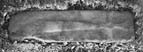
Object type: Grave-cover
Measurements: L. 125 cm (49.25 in); W. 32 > 30 cm (12.5 > 12 in); D. min. 10 cm (4 in)
Stone type: Pale yellowish brown (10YR 6/2), poorly sorted, clast-supported, quartz sandstone. The sub-angular to sub-rounded clasts range from medium-grained (0.3 mm) to very coarse-grained (1.5 mm), but are mostly medium- to coarse-grained in the range 0.4 to 0.7 mm; a few white mica flakes. Ward's Stone Sandstone Formation, Millstone Grit, Carboniferous
Plate numbers in printed volume: Ill. 727
Corpus volume reference: Vol 9 p. 263
(There may be more views or larger images available for this item. Click on the thumbnail image to view.)
The slab carries a full-length relief cross with lateral arms of type A1 and upper arm of type B6; the shaft swells towards the base. There are traces of a raised circle at the junction of the arms.
Appendix A item (stones dating from Saxo-Norman overlap period or of uncertain date)
In general, right-angled armpits are a late feature in Northumbrian sculpture (e.g. Lang 1991, ills. 158, 171; id. 2001, ill. 1148), though there are earlier examples from York Minster and San Vincenzo al Volturno, Italy (Lang 1991, ills. 80, 924). It is certainly a standard form on post-Conquest slabs (Ryder 1985; id. 1991, passim). The 'swollen' shaft is a type discussed under Hilbre Island 2 (p. 82); it appears to be a form dating to the eleventh century or later.
