Select a site alphabetically from the choices shown in the box below. Alternatively, browse sculptural examples using the Forward/Back buttons.
Chapters for this volume, along with copies of original in-text images, are available here.


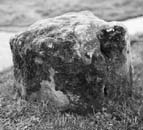
Object type: Possible cross-base or shaft
Measurements: H. 48 cm (18.8 in); W. 62 > 59 cm (24.4 > 23.25 in); D. 51 > 44 cm (20.1 > 17.3 in)
Stone type: Light brownish grey (5YR 6/1), poorly sorted, clast-supported, quartz sandstone. The sub-angular to sub-rounded clasts range from fine-grained (0.2 mm) to very coarse-grained (1.5 mm), but are mostly medium- to coarse-grained in the range 0.4 to 0.8 mm; a few fragments of white mica and white feldspar. Ward's Stone Sandstone Formation, Millstone Grit, Carboniferous
Plate numbers in printed volume: Ills. 728-9
Corpus volume reference: Vol 9 p. 263-4
(There may be more views or larger images available for this item. Click on the thumbnail image to view.)
The roughly squared stone is undecorated. If it once served as a socket then it has lost its socket hole.
Appendix A item (stones dating from Saxo-Norman overlap period or of uncertain date)
The site has a number of sockets, some clearly of pre-Norman date, but this stone has no distinguishing characteristics to suggest that it is work of the Anglo-Saxon period. There is another possible socket in the Rectory wood, known locally as 'the Druid's altar' (Flaxington 2001, 3; info. courtesy of Dr R. Trench-Jellicoe).
