Select a site alphabetically from the choices shown in the box below. Alternatively, browse sculptural examples using the Forward/Back buttons.
Chapters for this volume, along with copies of original in-text images, are available here.


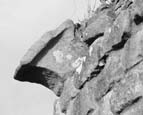
Object type: Architectural feature [1][2]
Measurements: H. c. 50 cm (19.5 in); W. 80 cm (31.5 in); D. 23 cm (9 in)
Stone type: Not accessed
Plate numbers in printed volume: Ills. 537-8
Corpus volume reference: Vol 9 p. 208
(There may be more views or larger images available for this item. Click on the thumbnail image to view.)
Both east and west faces carry a moulding border on their upper edge. The east face of the stone shows it to have a trapezoid-type form with a long narrowing 'tail' built into the fabric. It projects beyond the line of the wall on the northern face. The projecting and sloping upper surface appears to be flat and the stone has a marked overhanging 'lip' on its lower side. The visible parts of the north, south and west faces are slightly concave.
Lang grouped this carving with Y-shaped stones from Lythe and Lastingham as examples of gable-finials of a type well known in Ireland, but its form does not suggest that it served the same function (Lang 1991, 172; id. 2001, 167; see Crawford, H. 1914). Taylor and Taylor (1965, i, 313) were surely right to see it as 'the lowest stone of the water-tabling of the east gable', though their comparison with the depiction of the mausoleum on Heysham 1 (Ill. 508) is not particularly illuminating except to illustrate that buildings can have elaborate over-hanging eaves. In its present position the stone forms part of the phase 2 chapel, dated by Potter and Andrews (1994, 73, 128) as post-eighth century; it may, however, have been re-cycled from an earlier building.
[1] The difficulties of distinguishing between the original provenances of sculpture from this site have been emphasised by recent excavations (Potter and Andrews 1994, 104, and fig. 2). The following list therefore combines material from both St Peter's church and St Patrick's chapel.
[2] The following are general references to the Heysham stones: Robson 1850, 28; Jackson 1889, 33; Allen 1894, 4, 8; Micklethwaite 1898, 348–9; Taylor, H. 1898, 42; Howarth 1899, 9, 21; Nicholson 1899, 21; Grafton 1904; Ditchfield 1909, 117; Grafton 1909; Farrer and Brownbill 1914, 110; (–––) 1923, 288; Curwen 1925, 30; Collingwood 1927a, 15; Hogarth 1934; Bu'lock 1972, 67; Fellows-Jensen 1985, 402, 405; Crosby 1998, 30; Higham, N. 2004a, 27; Blair 2005, 216, 218, 309, 376, 457; Salter 2005, 42; Newman, R. M. 2006, 103.
The following are unpublished manuscript references: BL Add. MS 37550, items 617–46, 735–6; BL Add. MS 37551, items 72–5; Lancaster Public Library, no. PT 7; Manchester Public Library, Hibbert Ware S. MSS: Msf 091 H21, V, 64 (no. 5), 82 (no. 1); vol. 8, 98v. For the Hibbert Ware collection see Henry and Trench-Jellicoe (2005, 239–60).
