Select a site alphabetically from the choices shown in the box below. Alternatively, browse sculptural examples using the Forward/Back buttons.
Chapters for this volume, along with copies of original in-text images, are available here.


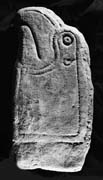
Object type: Architectural fragment or part of chair [1][2]
Measurements: H. 74 cm (29.25 in); W. 37 cm (14.5 in); D. 12 cm (4.75 in)
Stone type: Greyish orange pink (5YR 7/2), poorly sorted, clast-supported, quartz sandstone. The sub-rounded clasts range from medium-grained (0.3 mm) to granular (3.0 mm), but are mostly medium- to coarse-grained in the range 0.4 to 0.6 mm. Ward's Stone Sandstone Formation, Millstone Grit, Carboniferous
Plate numbers in printed volume: Ills. 532-6
Corpus volume reference: Vol 9 p. 207
(There may be more views or larger images available for this item. Click on the thumbnail image to view.)
The stone is carved on faces A and B only.
A (broad): The stone is roughly rectangular at the base but its upper shaping follows the outline of the forehead and beak of the bird form carved upon it. Decoration consists of a bird's head with a rectangular 'body', surrounded by a relief moulding, which reaches down over the greater part of the stone. The eye is formed by a flat boss, with central drilled hole, which is surrounded by a moulding which broadens (behind the eye) into a rectangular shape; this has an angular curling extension at the base. The upper mandible of the beak is outlined by a moulding and hooks over a short lower member.
B (narrow): A central raised flat moulding stretches up the stone and continues over to the (broken) end of the upper mandible.
In both its size and in its general composition of panelled rectangular base combined with a head, this stone is closely matched by a recent discovery at Skipwith in Yorkshire (Bailey 2008, ill. 29; Hall 2007b, fig. 4). In publishing the Heysham carving Cramp (in Potter and Andrew 1994) raised the possibility that it acted as a finial of either a building or a stone shrine, but rightly rejected these interpretations in favour of identification as a part of a chair. She suggested that the stone was set horizontally as an arm-rest, the bird-head terminal thus presumably representing an abbreviated version of the animals which top the arm-rests of such early medieval thrones as those at S. Ambrogio in Milan or S. Maria in Cosmedin in Rome (Fleury 1883–9, ii, pls. CLII, CLXV).
It is more likely however, and certainly better evidenced in Insular contexts, that both the Heysham and Skipwith stones originally acted as one of the two vertical finials to a high-backed chair. Depictions of both bird- and animal-headed finials in this position are known in eighth- and ninth-century Insular manuscripts, on a Pictish cross-slab from Kirriemuir, Angus, and on a tenth-century carving from Old Malton in Yorkshire, whilst Lang has convincingly shown that fragments from Lastingham can be reconstructed to form a slender version of this part of a chair (Alexander 1978, ills. 74, 178, 223, 263, 284; Henderson and Henderson 2004, ill. 314; Lang 1991, 196–7, 172–3, ills. 614, 617, 736). In addition there are animal heads from Liverpool Old Swan 1, Monkwearmouth and Tarbat which may have been elements of the same type of composite structure (Ills. 730–1; Cramp 1984, pl. 124.673–6; Henderson and Henderson 2004, ill. 313).
Like the bird on an enigmatic stone from Minnigaff, Kirkcudbright — possibly a reading desk — the head is of a form which was established in Style 2 ornament of the seventh century (Cramp 1994, 109, fig. 43). Such types persist however into eighth-century art (Bailey 1992).
[1] The difficulties of distinguishing between the original provenances of sculpture from this site have been emphasised by recent excavations (Potter and Andrews 1994, 104, and fig. 2). The following list therefore combines material from both St Peter's church and St Patrick's chapel.
[2] The following are general references to the Heysham stones: Robson 1850, 28; Jackson 1889, 33; Allen 1894, 4, 8; Micklethwaite 1898, 348–9; Taylor, H. 1898, 42; Howarth 1899, 9, 21; Nicholson 1899, 21; Grafton 1904; Ditchfield 1909, 117; Grafton 1909; Farrer and Brownbill 1914, 110; (–––) 1923, 288; Curwen 1925, 30; Collingwood 1927a, 15; Hogarth 1934; Bu'lock 1972, 67; Fellows-Jensen 1985, 402, 405; Crosby 1998, 30; Higham, N. 2004a, 27; Blair 2005, 216, 218, 309, 376, 457; Salter 2005, 42; Newman, R. M. 2006, 103.
The following are unpublished manuscript references: BL Add. MS 37550, items 617–46, 735–6; BL Add. MS 37551, items 72–5; Lancaster Public Library, no. PT 7; Manchester Public Library, Hibbert Ware S. MSS: Msf 091 H21, V, 64 (no. 5), 82 (no. 1); vol. 8, 98v. For the Hibbert Ware collection see Henry and Trench-Jellicoe (2005, 239–60).
