Select a site alphabetically from the choices shown in the box below. Alternatively, browse sculptural examples using the Forward/Back buttons.
Chapters for this volume, along with copies of original in-text images, are available here.


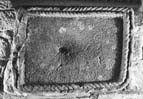
Object type: Plinth(?) [1][2]
Measurements: L. 76 cm (30 in); W. 52 > 55 cm (20.5 > 21.5 in); H. 20 cm (8 in)
Stone type: Greyish orange (10YR 7/4), moderately sorted, clast-supported, quartz sandstone. The sub-angular to sub-rounded clasts range from fine-grained (0.2 mm) to coarse-grained (1.0 mm), but are mostly medium- to coarse-grained in the range 0.4 to 0.6 mm. Ward's Stone Sandstone Formation, Millstone Grit, Carboniferous
Plate numbers in printed volume: Ills. 539-42
Corpus volume reference: Vol 9 p. 208
(There may be more views or larger images available for this item. Click on the thumbnail image to view.)
This rectangular stone (with a slight taper on its width) has an upper surface which is framed by a double cable moulding, slightly inset from the edge of the stone. In the middle, though somewhat off-centre, is a small round hole surrounded by a shallow depression. This hole emerges on the otherwise uncarved reverse into a funnel-like cavity.
There is no decoration on the narrow sides.
The hole, along with the shallow depression which has left a marked striation in its cutting, may be secondary since it is off-centre. The original function of the carving is uncertain. Cramp (in Potter and Andrews 1994, 111) suggested that it might have been a support for a column or a feature such as a lamp or stoup, whilst Dr R. Trench-Jellicoe has argued (in litt.) that it may have been a ritual footbath similar to a stone from Iona (Fisher 2001, 59 (K.106)). Though heavy cable-mouldings can be cited from a variety of dates in pre-Norman sculpture, this piece should probably be viewed as part of the same decorative suite as the imposts at St Peter's church (Heysham 15 below), which also have very bold cabling.
[1] The difficulties of distinguishing between the original provenances of sculpture from this site have been emphasised by recent excavations (Potter and Andrews 1994, 104, and fig. 2). The following list therefore combines material from both St Peter's church and St Patrick's chapel.
[2] The following are general references to the Heysham stones: Robson 1850, 28; Jackson 1889, 33; Allen 1894, 4, 8; Micklethwaite 1898, 348–9; Taylor, H. 1898, 42; Howarth 1899, 9, 21; Nicholson 1899, 21; Grafton 1904; Ditchfield 1909, 117; Grafton 1909; Farrer and Brownbill 1914, 110; (–––) 1923, 288; Curwen 1925, 30; Collingwood 1927a, 15; Hogarth 1934; Bu'lock 1972, 67; Fellows-Jensen 1985, 402, 405; Crosby 1998, 30; Higham, N. 2004a, 27; Blair 2005, 216, 218, 309, 376, 457; Salter 2005, 42; Newman, R. M. 2006, 103.
The following are unpublished manuscript references: BL Add. MS 37550, items 617–46, 735–6; BL Add. MS 37551, items 72–5; Lancaster Public Library, no. PT 7; Manchester Public Library, Hibbert Ware S. MSS: Msf 091 H21, V, 64 (no. 5), 82 (no. 1); vol. 8, 98v. For the Hibbert Ware collection see Henry and Trench-Jellicoe (2005, 239–60).
