Select a site alphabetically from the choices shown in the box below. Alternatively, browse sculptural examples using the Forward/Back buttons.
Chapters for this volume, along with copies of original in-text images, are available here.


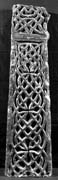
Object type: Cross-shaft with lower part of -head
Measurements: H. 157 cm (61.8 in); W. (top of shaft) 43 > 32.5 cm (16.9 > 12.8 in); head 35 cm (13.8 in); D. (top of shaft) 27.8 > 24.5 cm (10.9 > 9.6 in); head 24 cm (9.5 in)
Stone type: Sandstone, buff to pale brown, medium grained, quartz with subordinate feldspar, sparse mica grains. Quartz cemented. Upper Carboniferous, Millstone Grit Group. [G.L.]
Plate numbers in printed volume: Ills. 773-6
Corpus volume reference: Vol 8 p. 267-8
(There may be more views or larger images available for this item. Click on the thumbnail image to view.)
A cross-shaft of rectangular section. The form of the head is not quite clear, although most of the lower arm is present, as it has been cut away at the sides to accommodate the piece to its use as a step.
The angles are slightly rounded. Adcock (1974, I, 232) noted that the strands are flat on top but with sloping sides, not rounded as Collingwood (1909, 186) believed. The background surface has been dressed flat with a claw chisel.
A (broad): Part of the lower edge of a circular feature, perhaps surrounding the centre of the head, can be seen. The interlace in the lower arm is an angular pattern E, fitted to the shape of the arm, with outside strands. How this continues around the centre or higher in the arm is not clear. The zigzag effect above the top is an unusual formation relating to the continuation of the pattern around the head (but see a similar effect in reverse at the lower edge), but how this was done is unclear. The shaft has three and a half registers of pattern D with outside strands. The outside strands meet the diagonals in the top outside corners of the shaft, in the simplest possible form of terminal.
B and D (narrow): Both sides have the same pattern, a run of half pattern F with the loops all turned the same way along the vertical axis, and with outside strands; but the loops are upright on face B and pendant on D. Face D incorporates a free ring and a terminal like a closed-circuit pattern E loop, and there is a similar closed-circuit loop at the terminal of face B.
C (broad): Worn away
Collingwood (1909, 185–6) compared the pattern on face A to one on a probable impost from Kirby Hill, north Yorkshire (Lang 2001, 134–5, fig. 16, ills. 369–70), but although there are similarities in the pattern, the scale and unit measure are in fact very different. Adcock (1974, I, 231–6) grouped this cross with Addingham 2 and Waberthwaite 2 in Cumberland (Bailey and Cramp 1988, ills. 5, 8, 584–5), Hauxwell 1 in north Yorkshire (Lang 2001, ills. 311–14), and Kirkdale 8 and Hackness 1 in east Yorkshire (Lang 1991, ills. 457, 563), because of the unusually large unit measure and thin-stranded open interlace found in all. Closed-circuit elements, capricious breaks and occasional breakdowns in geometrical precision are the hallmarks of this group, for which she proposed a date in the late pre-Viking period, perhaps even carrying on into the tenth century. Adcock made a particularly close study of the technique of the Wakefield cross, and its patterns of wear, showing that these varied between the surviving broad face and the sides, suggesting to her that face A was only a partially completed work with the modelling unfinished, in which aspect it is comparable to some of the work on the Hackness shaft (Lang 1991, 139). She also found a difference in pattern concept along with the differences in technique: from the well-gridded and repetitive pattern on face A to the less regular patterns with their short-circuit elements on the narrow faces. She suggested that they could be explained either by the work having been begun by one craftsman and finished by another with different ideas; or begun by a craftsman copying a known monument with the use of templates, but then adding more of his own ideas.
An equally interesting point is that all the decoration on this cross is interlace, in itself an unusual feature; in this respect see also the discussion of Thornhill 2, which appears to be part of the same group (p. 258, Ills. 728–31).
