Select a site alphabetically from the choices shown in the box below. Alternatively, browse sculptural examples using the Forward/Back buttons.
Chapters for this volume, along with copies of original in-text images, are available here.


Object type: Fragment
Measurements: H. 36 cm (14.1 in); W. 27 cm (10.6 in); D. 18 cm (7.1 in)
Stone type: Sandstone, pale yellow -orange, ferruginous, medium to coarse grained, quartzo-feldspathic, quartz-cemented, slightly micaceous. Carboniferous — Pennine Coal Measures Group? [G.L.]
Plate numbers in printed volume: Ill. 826
Corpus volume reference: Vol 8 p. 285
(There may be more views or larger images available for this item. Click on the thumbnail image to view.)
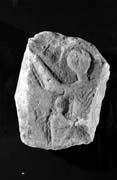
The surface is dressed back around shallowly modelled figures. A tall, possibly originally central figure is portrayed frontally. He is not nimbed. His features partly survive, crudely delineated. His right arm is extended outwards, bent upwards at the elbow.
The hand is incomplete. His left arm is missing but the shoulder line suggests it may have been similarly outspread. His body has several V- shaped modelling lines, either crude folds from a tunic, or crude indications of a naked ribbed chest. His body is missing below the waist. Below, on the figure's right, a smaller figure faces towards the centre, and holds his arms out towards the waist-level of the central figure.
Appendix A item (Stones dating from Saxo-Norman overlap period or of uncertain date)
It is not clear whether this fragment is a panel or part of a shaft or even a headstone. The figure group bears some similarities to the group on a panel from Bramham, near Leeds (p. 106, Ill. 74), which I consider possibly represents a Traditio Legis. The scale here is smaller however, and the V-shaped marks on the torso possibly do represent a naked breast: if so this possibly represents a Crucifixion scene. The subsidiary figure is then likely to be either the spear-bearer piercing Christ's side, or possibly a figure catching the flow of blood from the side in a chalice, therefore representing the Church. The carving is quite crude, and for that reason is difficult to date, but its particular type of crudity is not paralleled in pre-Conquest figure sculpture from the region.
