Select a site alphabetically from the choices shown in the box below. Alternatively, browse sculptural examples using the Forward/Back buttons.
Chapters for this volume, along with copies of original in-text images, are available here.


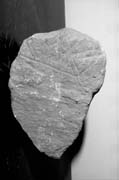
Object type: Fragment
Measurements: H. 33 cm (13 in); W. max. 22 cm (8.6 in); D. 9 > 5 cm (3.5 > 2 in)
Stone type: Not seen by geologist
Plate numbers in printed volume: Ills. 839-40
Corpus volume reference: Vol 8 p. 283-4
(There may be more views or larger images available for this item. Click on the thumbnail image to view.)
A (broad): Lightly incised, almost scratched, decoration on one end, perhaps the upper end of the face: one element appears to be part of a diaper or zigzag, but this element cuts through what seems to be a border, and the remainder cannot be described in terms of elements, though like the zigzag, parts seem to be double outlined.
B and D (narrow): Broken away
C (broad): Some fine scratched markings which do not appear to form part of an intentional decoration.
Appendix A item (Stones dating from Saxo-Norman overlap period or of uncertain date)
This appears to be the only possible example of apparently a number of 're-used 11th century grave markers' first noted in Mayes (1980, 20) and fully illustrated and described in Ryder (1993, 129–32, fig. 178). It is possibly part of a grave-marker, but is too incomplete even for this to be a safe assumption. The ornament is too slight, and too unclear as to what it actually is, to provide any certain evidence of dating. Comparisons with the grave-markers from Adel (above, p. 271), underline the crudity of the Tong piece, as Ryder (ibid., 132) acknowledges. Other fragments discovered in the excavations are clearly Norman, including some with incised chevron ornament. Two other fragments with incised markings are recorded by Ryder (ibid., 132, fig. 178, nos. 7 and 8), but although one appears to have an incised cross, they are even less convincing as grave-markers. These last two stones were not seen on visits to the church.
