Select a site alphabetically from the choices shown in the box below. Alternatively, browse sculptural examples using the Forward/Back buttons.
Chapters for this volume, along with copies of original in-text images, are available here.


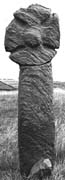
Object type: Complete cross-head and -shaft (the 'Mount Cross')
Measurements: H. 200 cm (78.7 in); W. (from bottom) 40 < 42 > 31 cm (15.7 < 16.5 > 12.1 in); 56 cm (22 in) across head; D. (from bottom) 18 < 20 > 19 cm (7.1 < 7.8 > 7.5 in); 14 cm (5.5 in) at arm head
Stone type: Sandstone, clean, brown colour, coarse to very coarse with sporadic, small white quartz pebbles. Low angled cross-bedding laminae evident along length of the shaft. Upper Carboniferous, Millstone Grit Group. [G.L.]
Plate numbers in printed volume: Ills. 769-72
Corpus volume reference: Vol 8 p. 266-7
(There may be more views or larger images available for this item. Click on the thumbnail image to view.)
A cross-shaft of slab-like section with a plate head of type E8. When it was being restored after being thrown down in 1898 (see above), it was noted that the foot of the shaft was shouldered 'as if it had once been intended to be fixed in the socket of a stone base' (Newell 1911, 175), although no base was found.
A and C (broad): The cross-head has a large boss at the centre of both broad faces, each with traces of an encircling ring: there is no other visible ornament.
B and D (narrow): The only decoration on both faces is a horizontal double moulding just below the head.
The plate head was a popular form in cross-heads of the Anglo-Scandinavian period in Yorkshire (Lang 2001, 26). The form of cross superimposed on the plate in this area is very varied, and some are very plain, as for example Gilling West 4 (ibid., ills. 277–9). Grave-markers with angular armpits and a central boss on what appears to be a squarish plate are thought to be of the first half of the tenth century, because of their association with a particular type of hogback: see for example Lythe 9 (ibid., 157, ills. 499–502).
Taylor (1906, 116) classed this with the Godley Lane (Burnley) and Whalley pre-Norman crosses, both in Lancashire. These have arms of a similar form, though not as exaggerated; and the Godley Lane cross appears equally plain apart from its ringed boss centre: both, however, are free-armed heads, so the comparison is by no means exact. He described this one as the last on the Long Causeway, though half a mile on the Yorkshire side of the border. Kenyon (1991, 102) noted that plain crosses such as this are found along the Pennine flanks, citing examples in the townships of Aighton, Bailey and Chaigley, also Cliviger, Godley Lane (Burnley), and Foulridge. Allen (1892–5, 141) thought them possibly guide posts over the moors. There is no real evidence for the function or placing of this cross, however.
