Select a site alphabetically from the choices shown in the box below. Alternatively, browse sculptural examples using the Forward/Back buttons.
Chapters for this volume, along with copies of original in-text images, are available here.


Object type: Grave-marker or part of cross-head
Measurements: H. 36.8 cm (14.5 in); W. 16.5 cm at base < 18.5 cm at lower moulding > 14.2 cm across head (6.5 < 7.3 > 5.6 in); D. 11 cm at base > 10.2 cm > 8 cm at top (4.3 > 4 > 3.2 in)
Stone type: Fine-grained, well sorted feldspathic sandstone. Colour light grey (10YR 7/2). Perhaps the Doubler Stone Sandstone, Namurian, Upper Carboniferous. [J.S.]
Plate numbers in printed volume: Ills. 777-83
Corpus volume reference: Vol 8 p. 268-9
(There may be more views or larger images available for this item. Click on the thumbnail image to view.)
It is very unclear what this monument was originally. It has at some time been shaped as a round-headed grave-marker, but it is possible that this was originally one arm of a large free-armed cross-head of type D9. The evidence for this is in the shape of the lower part of face A, which looks like the first long curve of such a head. The shaping and plain dressing for the under-arm is still clear on face D. The end of the arm has been cut down to form the grave-marker shape. The round head is unbalanced relative to the shaft.
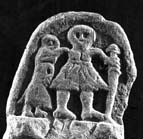
A (broad): There is a round moulding around the head and a flat moulding, broken at the top left, edging the top and sides of the 'shaft'. In the head panel is a frontal short-skirted figure. His garment is waisted and folds represented by inverted Vs are indicated in the skirt. He holds or touches a thin long-skirted female figure with his right hand. One of her arms hangs down in front of her. The other arm may be entwined with that of the central figure. In his right hand the central figure holds a large sword with a domed pommel, handgrip and handguard. Below in the 'shaft' is a flat-strap Stafford Knot (simple pattern E) with strands that cross, before (presumably) continuing into other arms of the original head.
B and D (narrow) and E (top): Face B is almost completely broken away below the top of the round head; face D is also broken but the lower part shows the curve and smooth dressing of an armpit or under-arm curve. Above the breaks the top and sides have been shaped to a curve and edged with a roll moulding, deeply cut on the inner surface. The space between the edge mouldings has been dressed flat.
C (broad): There is a round moulding surrounding the head panel, which contains a second frontal figure, again with a short, wide skirt, holding a battle-axe, blade down, in his right hand, and a sword (again with pommel grip and guard) in his left. The pommel is rather differently shaped to that on face A. Below this the surface has been hacked away.
This piece has a near parallel in Otley 6 (p. 223, Ills. 591–6, 608), from just across the river Wharfe. Bailey (1996a, 93–4) concluded that scenes such as this, of which there are a number in the areas of Scandinavian influence, reflected the 'martial ideal' of the incomers, since they have no trace of a specifically Christian theme. Such pieces seem to be commemorative portraits of the dead, showing them as warriors carrying items of contemporary weaponry. There are examples of the standing armed figure from Sockburn, co. Durham, no. 5 (Cramp 1984, pl. 131.715); Brompton 3B and Kirklevington 3A, in north Yorkshire (Lang 2001, ills. 38 and 408); and of the seated frontal type, most famously in east Yorkshire on Middleton 2A and 5A (Lang 1991, ills. 677, 688).
The only parallel to the pair of figures on face A at Weston is on Kirklevington 6A (Lang 2001, 144–5, ill. 420). Bailey (1996a, 94) saw this as an example of female protection, while Lang saw the two scenes as more enigmatic, with both rescue and aggression as possibilities. There are other alternatives, however. For example, although the female figure at Weston is slight in comparison with the centred male, if the one is portraiture of the deceased, why not the other? There are Anglo-Saxon inscriptions on sculptures commemorating women, as for example the abbess Oedilburga, on the Hackness cross (Lang 1991, 135–41, ill. 458; Farr 1999, 378–92). There is also evidence from Scandinavia, and from the Isle of Man, of inscriptions on memorials to women. But there is also evidence from Scandinavia (but not from the Isle of Man) for presumably high-status women named in inscriptions as commissioners of memorials (Jesch 1991, 48–74; and see Thornhill 2 above (p. 258)). A primary motive of such monuments was the establishment of legal inheritance in the heirs. Either of these possibilities seems as likely as the two previously suggested, both of which are unconvincing as subjects for grave-markers. There is a possible parallel in a fragment of a cross-shaft from Neston, Cheshire, which also has two figures, a male and female standing together in which the female appears to hold the male: it has been suggested that this commemorates a deceased couple (White 1986, 53, fig. 3.3, pl. 2; Harding 2002, 137–40), although it could also represent the deceased and a female commissioner. However, in this case the angel placed horizontally over the pair could suggest other possibilities.
