Select a site alphabetically from the choices shown in the box below. Alternatively, browse sculptural examples using the Forward/Back buttons.
Chapters for this volume, along with copies of original in-text images, are available here.


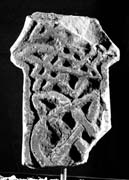
Object type: Upper part of cross-shaft and lower arm of -head [1]
Measurements: H. 27 cm (10.6 in); W. 14.5 > 13 cm (5.7 > 5.1 in) top of shaft; 18 cm (7.1 in) lower arm; D. 10.5 > 10 cm (4.2 > 3.9 in)
Stone type: Sandstone, pale brown, fine to medium grained, quartz with subordinate feldspar, sparse mica grains. Quartz cemented. Upper Carboniferous, local Pennine Coal Measures Group. [G.L.]
Plate numbers in printed volume: Ills. 743-6
Corpus volume reference: Vol 8 p. 262-3
(There may be more views or larger images available for this item. Click on the thumbnail image to view.)
The upper part of a shaft of a small cross of rectangular section, in one piece with the lower arm of the head, with an arm of type B or E. The sides are edged by narrow flat mouldings.
A (broad): Filled with two tangled irregular interlaces, close-packed in the cross-arm, looser and leaving more open background in the shaft.
B (narrow): A worn, large-scale interlace, a half pattern or twist, although what survives looks like a closed-circuit pattern formed from two complete linked ovals.
C (broad): This is rather worn, but the evidence suggests that Collingwood (1915a, 247, fig. l) was correct in his reconstruction of the pattern in the shaft as two and a half registers of closed-circuit pattern B. The head has a larger scale interlace, terminating in pointed loops in the lower corners, which possibly develops from the centre strands of the shaft pattern.
D (narrow): A continuous interlace, very worn, with joined terminals at the top. It could be based on closed-circuit pattern F as Collingwood interpreted it.
The angularity of the interlace and the use of closed-circuit elements on face B could suggest a date when an Anglo-Scandinavian taste was beginning to prevail. However, many of the elements also show a connection with the major monuments on this site. The pattern on face C is paralleled on the Rastrick cross-base (Ill. 628) which has a similarly fine strand, though there the interlace is also more open.
