Select a site alphabetically from the choices shown in the box below. Alternatively, browse sculptural examples using the Forward/Back buttons.
Chapters for this volume, along with copies of original in-text images, are available here.


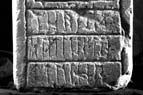
Object type: Part of cross-shaft [1]
Measurements: H. 51.5 cm (20.2 in); W. 20.2 > 18.3 cm (8 > 7.2 in); D. 10.8 > 10.4 cm (4.2 > 4.1 in)
Stone type: Sandstone, buff to pale orange brown, fine to medium grained, quartz with subordinate feldspar, sparse mica grains. Fine quartz-filled fractures, sporadically cross-cut the fabric. Upper Carboniferous, local Pennine Coal Measures Group. [G.L.]
Plate numbers in printed volume: Ills. 738-42
Corpus volume reference: Vol 8 p. 261-2
(There may be more views or larger images available for this item. Click on the thumbnail image to view.)
An incomplete tapering cross- shaft of rectangular section. The angles are squared and all faces have an incised border on the vertical edges.
A (broad): (i) A panel framed on all sides by a double incised border. There was clearly another panel above, of which only a tiny fragment has survived. Within the panel the carving is very worn as well as very shallow. The panel is divided vertically by a narrow stem which stops above an interlace strand at the bottom of the panel and rises to the top where it bifurcates just under the upper border to form a shallow arch over each half of the panel, terminating at the top side edge. Swellings at the ends of this arch suggest it is a vestigial plant form. On either side below is an animal, facing outwards, each animal with a foreleg, lower limb and a tail involved in a simple twist which extends to the base of the panel, where the two are interlinked. Each head has open blunt jaws, swallowing the end of its own tail. (ii) Below, the outer incised vertical borders extend to the foot of the shaft. Within the area thus framed is a runic inscription.
Inscription The runes are cut in a rectangular panel, divided into three horizontal lines about 4.5 cm high (Ill. 738). The characters are rather faintly cut, but the stone is little weathered, and the text is clear to read and appears to be complete. It runs:
This is evidently to be interpreted as 'Eadred set up [this monument] in memory of Eateinne' where the second personal name is probably a form of Eadþegn (see below) . There are two other awkward readings. At the start of line 2 a clear, short upright stands below the left-hand vertical of 's'. Probably this is a carver's mistake, the base of the character started in the wrong place. It is here transliterated as *. Just possibly, however, it is an intentional 'i', either cut small on purpose or squeezed in belatedly (cf. the second 'i' on Thornhill 2, above). Page (1999, 48) considers whether 'isete' might stand for gisette, which would be an acceptable variant verbal form. He concludes, however, that the line is 'far more likely to be an error' (ibid., 154). There is also some uncertainty over 'æfte'. The absence of a final –r here may be an error; but the same form seems to have been present on Thornhill 2 (above), and there may have been a comparable one also on Collingham 2 (p. 121). Whether this is an ancient inherited Old English r-less form directly related to Old Norse aft — very common on Scandinavian Viking-age memorials — or whether the loss of final –r is an independent development in Old English dialect, is not clear.
B (narrow): Plain within its incised edges which continue to the base of the shaft.
C (broad): The face is divided into two panels, each with its inner incised border. Only a small part of the upper panel survives. There seems to be a lower border for the lower panel. Both panels are completely plain.
D (narrow): Part of an upper panel and a complete lower panel with inner incised borders, as on face C.
This is organised in a style very similar to Thornhill 3, with only one decorated face and three faces plain except for the incised borders. The carving is very shallow. There seems little to parallel the animal ornament directly (see Chap. V, p. 57).
Inscription The inscription belongs to the group of vernacular memorials discussed above (Chap. VIII, pp. 79–84), and represented by three other examples at Thornhill (nos. 1, 2 and 3) and one from neighbouring Dewsbury (no. 10).
Eadred is a common Old English masculine personal name. Runic 'eatei nne' is probably to be taken for a form of another Old English masculine name, normalised as Eadþegn, though if so it has undergone considerable modification. The unvoicing of –d– > –t– before –þ– is expected (cf. the spelling eatðegn, numerous times, for this same name in the ninth-century Durham Liber Vitae [Sweet 1885, 162, lines 302, 329, etc.]). A further simplification of –tþ– > –tt–, written with a single runic 't', is also straightforward. In the deuterotheme palatal g may have vocalised, to judge by the choice of the rune 'ɨ' (Page 1999, 141 suggests that the sound would be 'almost vocalic'). And finally 'nn' appears to be a spelling of –n– without basis in pronunciation. Page discusses various manifestations of inorganic doubling (1962, 903 [1995, 100]; 1999, 141) and is tempted to suggest that here it may have been a convenience introduced simply to fill out the space on the panel (1999, 152).
On the appearance of the relatively rare Old English runes 'ea' and 'i' in this inscription see Page 1961, 69–70 [1995, 74–5]; Page 1968, 128 [1995, 137]; Parsons 1999, 83–4.
