Select a site alphabetically from the choices shown in the box below. Alternatively, browse sculptural examples using the Forward/Back buttons.
Chapters for this volume, along with copies of original in-text images, are available here.


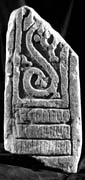
Object type: Lower part of cross-shaft [1]
Measurements: H. 51 cm (20 in); W. 23 > 21.8 cm (9 > 8.6 in); D. 14.5 > 14 cm (5.7 > 5.5 in)
Stone type: Sandstone, buff to pale orange brown, fine to medium grained, quartz with subordinate feldspar, sparse mica grains. Fine quartz-filled fractures, sporadically cross-cut the fabric. Upper Carboniferous, local Pennine Coal Measures Group. [G.L.]
Plate numbers in printed volume: Ills. 733-7
Corpus volume reference: Vol 8 p. 259-61
(There may be more views or larger images available for this item. Click on the thumbnail image to view.)
The lower part of a tapering cross-shaft of rectangular section. The angles are squared and all faces have a deeply incised border at the sides and the foot. There is a plain section at the foot of all faces, suggesting that this is the foot of the shaft.
A (broad): (i) A panel, incomplete at the top, with an inner incised border. The panel contains two volutes of a simple scroll, starting with a volute without stem or root. The first volute terminates in a trefoil leaf or flower. A drop leaf or bud, also tri-lobed but truncated, fills the lower right corner of the panel, and another sprouts from the top of the volute. The second volute terminates in the same manner as the first, and also has a tendril dropping into the spandrel below, this time with a rather rounded bud. Above in the spandrel to the left is a pointed leaf dropping from the missing next volute. (ii) Below is a runic inscription in three lines with incised framing lines above and below. Page (1999, 141) says that after this, on the border, is an illegible addition.
Inscription The runes are cut in a rectangular panel, divided by framing-lines into three horizontal lines, each about 4.5 cm high (Ill. 737). The text appears to have continued in the right-hand border opposite the third line, but damage to the stone here renders this part practically illegible. The whole surface of the stone is weathered, and the runes are not deeply cut. Most of the inscription can, however, be made out, as follows:
In the first line, before 'þ', the bases of two staves are visible, possibly with the impression of the joining arms of 'e' between them. At the beginning of the second line, there appears to be a bow, as of 'w' or 'r', followed by the faint traces of two staves — probably too widely spaced simply to represent two single-staved runes —, followed by the damaged traces of the stave and arms of 't'. From the context, it is practically certain that together this makes some form of the name Eþelberht. The first rune is surely 'e'. The first character of line 2 will have been 'r'; the next sequence is uncertain, but the available space suggests that it might have involved one wide rune, like 'h' or 'e', plus a thinner one. Various possibilities could be paralleled in inscriptions or manuscripts, including –berhct, –bercht, –berect, –bereit, –beriht.
Weathering at the end of line 3 is particularly bad. The final character within the panel is certainly 'r'. Before it fragments of the stave and both arms of 'o' are visible. There is also a suggestion of a line connecting the lower arm with the stave, forming a low bow. Page (1959a, 260) felt that this may have been intended, and proposed 'þ/or' and 'd/o/r' as alternatives to 'or'. Outside the rectangular panel, beside this line, there are traces of one further rune before the surface is broken away. The fragments comprise a stave, with unclear traces to its right: Page (ibid., 262) suggested 'l', 'æ', 'w', 'b', 'a' or 'o'!
B and D (narrow): Plain apart from the deeply incised border. The border on face D is lower on the shaft than on B.
C (broad): Plain, except that the incised border is double.
This could possibly be the lower part of Thornhill 8 (Ills. 755–8). A cross or shaft, plain on all sides but one broad face, immediately brings to mind the staff-crucifix at Kirkburton (Ills. 416–24), also in the Calder valley, and it is possible that this plain style at Thornhill continued to be influential in the later period. The mouldings are different, however, and so is the style of cutting. The fragment of scroll, lacking a root or starting point, is unusual, though there are other examples of longer scrolls in west Yorkshire in which the stem stands directly on the panel edge without a root. The tri-lobed bud and heart- shaped leaf is reminiscent of the shaft or base fragment at Dewsbury, no. 14 (Ill. 235).
Inscription The first part of the inscription is clearly to be interpreted as 'Eþelbercht set up [this memorial] in memory of Eþelwini'. As discussed above, the exact form of the first personal name is unclear: –bercht is only one of various possible spellings for the deuterotheme. A second problem of detail arises from the sequence 'settæfter'. It is perhaps likely that the carver has here omitted a vowel: 'settæ æfter' — or perhaps more probably 'sette æfter' (to judge by the quality of the unstressed vowels in the other Thornhill inscriptions) — would be more expected spellings. Alternatively it is possible that the 'æ' was intended to do double duty here, ending the verb and beginning the preposition: for discussion of this point see Page 1962, 907 [1995, 103]; Page 1999, 56, 154.
The main part of the text might be normalised, with some reservations, therefore, as Old English Eþelbercht sette æfter Eþelwini.
The two masculine personal names are both commonly recorded in Anglo-Saxon sources. The inscription belongs to the group of vernacular memorials discussed above (Chap. VIII, pp. 79–84), and represented by three other examples at Thornhill (nos. 1, 2 and 4), together with one from neighbouring Dewsbury (no. 10). This instance differs from Thornhill 4 because it continues after the name of the deceased, and it differs from many of the rest of the group because the continuation appears to be brief — perhaps a word or two — and because the surviving runes are not consistent with a form of the word becun 'monument'. The reading 'or–' suggests that the text here may have gone into Latin: ora(te) 'pray' can be paralleled on memorial stones, and would be equivalent to Old English gebiddaþ in longer vernacular texts. Page (1959a, 264) alternatively discusses the possibility that some form of byname or patronymic may have followed the deceased's name.
