Select a site alphabetically from the choices shown in the box below. Alternatively, browse sculptural examples using the Forward/Back buttons.
Chapters for this volume, along with copies of original in-text images, are available here.


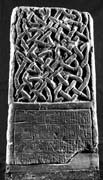
Object type: Part of cross-shaft [1]
Measurements: H. 59 cm (23.2 in); W. 31 > 28 cm (12.1 > 11 in); D. 19 > 18 cm (7.5 > 7.1 in)
Stone type: Sandstone, pale brown, medium to coarse grained, quartz with subordinate feldspar, sparse mica grains and white kaolinitic patches. Quartz cemented. Low angled cross bedding evident, parallel to lettered face. Upper Carboniferous, Millstone Grit Group. [G.L.]
Plate numbers in printed volume: Ills. 728-32
Corpus volume reference: Vol 8 p. 258-9
(There may be more views or larger images available for this item. Click on the thumbnail image to view.)
A cross-shaft of tapering rectangular section. The edge mouldings though considerably battered appear to have been flat. The carving is shallow with the surface of the strands only slightly modelled, and the interlacing strands interrupt and cut through those over which they are meant be seen as passing.
A (broad): The only panelled face. (i) Angular flat interlace, two registers of turned pattern E with outside strands. The complete register at the bottom has cross-joined terminals, the upper register is incomplete. A flat horizontal border separates this panel from that below. (ii) An incomplete runic inscription set within framing lines.
Inscription The runes are cut in a rectangular panel, divided into four by horizontal framing lines (Ill. 732). The bottom of the panel is broken away, causing damage to the bases of the last line of characters, though all are clearly legible. Contextual parallels suggest that this will have been the last line of the inscription. Elsewhere the stone surface shows some signs of weathering, but the runes are largely clear:
| + j i l s u i þ : a r æ r d e : æ f t. | b e r h t s u i þ e · b e k u n | o n b e r g i g e b i d/d a þ | þ æ r : s a u l e |
The runes are approximately 5 cm high. Although the first 'j' is worn, and the last line and the end of the third are damaged by the break, the only uncertainty in reading comes at the end of line 1. Here faint traces of two staves can be seen, probably those of 'e' — in some lights the joining arms of that character seem also to appear. There is then a short space before the edge of the panel, but it does not look wide enough for 'r', and there is no sign of incision. Probably here, as on Thornhill 4, was the form æfte, rather than the usual æfter. The second 'i' in the first line is small and sits high between 'u' and 'þ'. It could possibly be a genuine variant half-height character, but is more likely squeezed in having been accidentally omitted (Page 1999, 154).
B (narrow): A continuous interlace, four registers of closed-circuit pattern F. The lowest register is elongated to fill the space. It is however incomplete at the bottom and at the top. The carving is very clumsy.
C (broad): A continuous interlace, five registers of pattern A
D (narrow): A continuous interlace, three registers of closed-circuit pattern F and possibly a fourth, distorted, register at the foot.
The 'stopped-plait' form of interlace is usually taken to be a late feature. The distortions suggest that the interlace was laid out using templates rather than grid points applied to the surface of the stone. The patterns are accurately followed through, if slightly distorted and sometimes clumsy in execution. Thornhill 9 (Ills. 759–63) could possibly be the head of this cross. The scale and style of the pattern, and the large unit measure (c. 9 cm) on face C suggests that this is related to a group of ninth-century crosses identified by Adcock (1974, I, 255–6) as centred on Deira, although there are also examples at Addingham and Waberthwaite in Cumbria. Adcock did not consider the shafts from Thornhill in her analysis, but Wakefield 1 (Ills. 773–6) is an important example of this group. The use of templates is also typical of this group. Thornhill 2 shares with Wakefield 1 a distinctive decorative scheme confined to interlace, which appears on all four faces. The fragment of a cross-head, Thornhill 9, shares the same style and approach to design.
The fact that both the commissioner and the commemorated on this stone are female is worthy of note: indeed Okasha (2001, 82) claims this is the only certain example of a female commissioner, noting only one other doubtful example, also a sculpture.
Inscription The inscription forms two lines of loose verse, running:
'Gilswiþ raised up, in memory of Berhtswiþ, a beacon on a hill. Pray for her soul'. The two personal names are feminine. Berhtswiþis attested in the Durham Liber Vitae (Sweet 1885, 154, line 26) and elsewhere. Gilsuiþ probably represents a normalised Gislswið. This name is not otherwise found in Anglo-Saxon sources (though Searle 1897, 259 cites a Continental equivalent Gisalsuind), but it is of regular Old English form, though Gisl– is not common as a prototheme.
The inscription belongs to the group of vernacular memorials discussed above (Chap. VIII, pp. 79–84), and represented by three other examples at Thornhill (nos. 1, 3 and 4) and one from neighbouring Dewsbury (no. 10). There are two noteworthy variations in the text employed on this stone. The choice of the verb aræran 'to raise up' is paralleled only on the Overchurch, Cheshire, rune-stone; settan 'to set up' is more commonly used, and appears on the two other Thornhill rune-stones (nos. 3 and 4 below). Secondly, the phrase bekun on bergi is found only here (and possibly also on Thornhill 1, see above); it corresponds to becun æfter his bæurnæ and becun æfter beornæ 'a beacon in memory of his child [or his lord]' at neighbouring Dewsbury (no. 10, p. 143) and at Great Urswick, Lancashire (Bailey and Cramp 1988, 148–9), and becun æftær eomæ 'a beacon in memory of his uncle' at Falstone, Northumberland (Cramp 1984, 172) . It may be that any relationship between sponsor and deceased — and the sharing of the deuterotheme –swiþ suggests that there may have been a family connection — could not be expressed with a term alliterating on b–, as it could be at Dewsbury and Great Urswick. The tag on bergi may have been preferred at Thornhill to a relationship-term that lost the alliteration (though this was tolerated at Falstone).
Page translates on bergi as 'on a mound', and although no evidence seems to have been brought forward, it is possible that there may have been some sort of tumulus associated with the Thornhill church-site. However, since the church at Thornhill stands, as its name suggests, on a marked hill beside the Calder valley, it is perhaps likely that berg here refers simply to the place's situation. Parsons 2002, 184–7, notes an instance of variation between berg and hyll in a place-name.
For the difficult rune transliterated here as 'j', apparently used for palatal g, see Parsons 1999, 123–6. As noted above (p. 83), the use of u for w in the name-element swiþ may suggest the influence of roman-script orthography.
