Select a site alphabetically from the choices shown in the box below. Alternatively, browse sculptural examples using the Forward/Back buttons.
Chapters for this volume, along with copies of original in-text images, are available here.


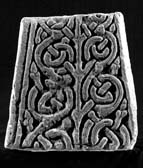
Object type: Part of shaft [1]
Measurements: H. 31 cm (12.1 in); W. 30 > 23.5 cm (11.8 > 9.2 in); D. 28.5 > 22.8 cm (11.2 > 8.9 in)
Stone type: Sandstone, pale brown, fine to medium grained, quartz with subordinate feldspar. Quartz cemented. Upper Carboniferous, local Pennine Coal Measures Group. [G.L.]
Plate numbers in printed volume: Pls 747-50
Corpus volume reference: Vol 8 p. 263
(There may be more views or larger images available for this item. Click on the thumbnail image to view.)
A fragment of cross-shaft, or less likely a base, almost square in section as it now appears. The missing face B has been cut away at a diagonal, so that face A is almost complete, while face C has lost much more of its width.
A: There is a double rolled edge moulding on the left, but only part of the narrower inner moulding on the right as it meets the missing face B. The area between is filled with a stylised median-incised bush-scroll, in which the 'volutes' are formed from an almost independent interlacing strand on either side (possibly developing from a point on the stem below the break), and is further complicated because it laces around budding twigs which fork in pairs directly from the central stem. The buds are pointed and lobed. The interlacing strand on the left is complicated by bifurcating at intervals, the strand on the right is simpler. There are ridged nodes on the interlacing strand even at points when they do not bifurcate.
B : Missing
C: This face has a most elaborate vertical border surviving on the right. On the outside is a broad outer and narrower inner roll moulding. Within this is a vertical strip with from the top three elements of step pattern type 2 and one of meander type 2. This is flanked by three further vertical rounded mouldings. On the left are the remains of a panel with a few curved elements and one pointed leaf apparently from a scroll.
D: The dressed surface is divided vertically by an incised line. On either side, starting from the edge, is an outer wide and narrow inner roll moulding, a flat plain area, two further vertical mouldings and a second plain area.
This piece shares a love of mouldings and elaborate borders with Thornhill 7 and Dewsbury 15 (Ills. 237–9). See also the Dewsbury shaft or base no. 14 with its bush-scroll and double edge moulding (Ills. 235–6).
