Select a site alphabetically from the choices shown in the box below. Alternatively, browse sculptural examples using the Forward/Back buttons.
Chapters for this volume, along with copies of original in-text images, are available here.


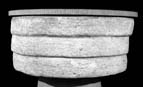
Object type: Architectural piece: a drum, probably a capital [1]
Measurements: H. 44 cm (17.4 in) Circumference at top: 345 cm (135.8 in), at bottom: 318 cm (125.2 in) Diameter at top: 106 cm (41.7 in), at bottom: 101 cm (39.7 in)
Stone type: Sandstone, clean, pale buff-brown colour, coarse to very coarse with sporadic, small white quartz pebbles. Low angled cross-bedding laminae cross-cut the stone. Upper Carboniferous, Millstone Grit Group. [G.L.]
Plate numbers in printed volume: Ill. 676
Corpus volume reference: Vol 8 p. 240-1
(There may be more views or larger images available for this item. Click on the thumbnail image to view.)
The drum as it now stands narrows from top to bottom in four plain horizontal bands (fasciae), each one stepped in from the one above. Underneath there is a shallow outer rim, about 10 cm (4 in) wide around its circumference within which the surface is cut back. The present setting does not permit examination of either upper or lower surface, so it is not known if there any holes, such as Lewis or cramp holes, which could prove an origin in Roman work.
Similar pieces were found reused in an eleventh-century or earlier context at St Mary Castlegate, York (Hall 1975b, 19–21, figs. on 20–1; Wenham et al. 1987, 153, pl. XXVIII; Hall 1995, 25). There it was noted that while there were cramp holes, Lewis holes and sockets on these examples (which indicated a previous use in the Roman period), the treatment of the sides was clearly secondary, and unlikely to be Roman (Lang 1991, 117, ills. 413–15); and that apart from Ripon the closest parallels were from St Mary's, Reculver, Kent. These pieces are now in the crypt of Canterbury Cathedral but an early drawing shows them in situ in the church before it was demolished, as capitals of columns supporting the arcade between the nave and the chancel (Tweddle et al. 1995, 163, ill. 127). Blagg (1981, 52) showed that these were similar in design and concept to the impost block placed above the capital initially in fifth-century churches around the Mediterranean, in order to expand the bearing surface of the capital beneath the springing of an arch. He suggested that this technique was among those brought by the missionaries who first restored the tradition of building in stone, with columns and arches, from the late sixth century. The visible drum at Ripon is so like these pieces it would appear to have fulfilled the same function. Wilfrid's biographer Eddius Stephanus records his building of the cathedral at Ripon as a church of dressed stone with various columns ('variis columnis': Colgrave 1927, 36–7, ch. 17). It is possible that the two drums from Ripon, including the one removed from the crypt and reused as an altar base, were in fact capitals, or impost blocks, from these columns. Such stepped capitals appear supporting architectural arched frames on Collingham 1, Dewsbury 3, Dewsbury 4, and Otley 1 (Ills. 167, 196–7, 198–200, 564), and there are numerous examples in manuscript paintings — the canon tables of the Lindisfarne Gospels, for example (Alexander 1978, ill. 32).
