Select a site alphabetically from the choices shown in the box below. Alternatively, browse sculptural examples using the Forward/Back buttons.
Chapters for this volume, along with copies of original in-text images, are available here.


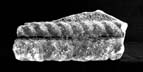
Object type: Fragment
Measurements: H. 20.5 cm (8.1 in); W. max. 9 cm (3.5 in); D. max. 7 cm (2.8 in)
Stone type: Sandstone, pale yellowish brown, coarse to very coarse grained, quartzose, with white kaolinite patches throughout. Carboniferous (Millstone Grit Group). [G.L.]
Plate numbers in printed volume: Ills. 645-6
Corpus volume reference: Vol 8 p. 241
(There may be more views or larger images available for this item. Click on the thumbnail image to view.)
This could be the vertical edge of a cross-shaft, but it could also be a horizontal edge of an architectural piece.
A (broad): All that survives is a cable moulding inside a flat border.
B (narrow) and C (broad): All other sides are broken away but tool marks indicate preparation for reuse.
D (narrow): There is a trace of a double flat moulding at one end of this face.
Too little survives for certainty, but the cable edging could suggest a sculpture of similar date to Ripon 2, 5 and 6. Tweddle (1996, 129) thought it might be a fragment of an impost rather than of a cross-head, and therefore likely to be of tenth- to eleventh-century date, possibly even post-Conquest, by analogy with other imposts of the same form. However, it could possibly be a fragment of a cross-shaft.
