Select a site alphabetically from the choices shown in the box below. Alternatively, browse sculptural examples using the Forward/Back buttons.
Chapters for this volume, along with copies of original in-text images, are available here.


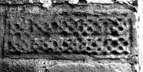
Object type: Two lengths of string-course or imposts [1] [2]
Measurements: Both pieces have the same dimensions: H. 19 cm (7.5 in); L/W. 78 cm (30.7 in); D. 52 cm (20.5 in)
Stone type: Both medium-grained well-sorted, feldspathic Millstone Grit with a light yellow brown colour (10YR 6/4). A coarser grained variety of Ripon (cathedral, St Peter and St Wilfrid) 4 — Plompton Grit, Namurian, Upper Carboniferous. [J.S.]
Plate numbers in printed volume: Ills. 671-5
Corpus volume reference: Vol 8 p. 239-40
(There may be more views or larger images available for this item. Click on the thumbnail image to view.)
On the west face of the buttress, two lengths of a string-course are visible, 9aA on the left and 9bA on the right. Each length also has one adjacent side visible: 9aD facing north and 9bB facing south towards the cathedral. The probable lengths suggest that these could have been imposts. Both are decorated with interlace with highly modelled strands and are edged by single flat-band mouldings. The narrower faces are both more weathered than the broad faces.
9aA (broad) has five registers of complete pattern C; 9aD (narrow), its adjacent face, has five registers of turned pattern F with included terminals.
9bA (broad) has five registers of spiralled half pattern A. This pattern is less dense than its companion, and has a heavier strand to compensate. Its adjacent face, 9bB (narrow), has five registers of complete pattern F.
Adcock (1974, I, 93) has pointed to the fundamental unity of the two designs on these imposts, with all four faces having five divisions emphasised by the use of glides. These imposts are in fact central to a group she calls 'the mature sculptured interlace of the Ripon area', a group which includes within it Ripon 2, above, and crosses from north Yorkshire: Croft 1, Cundall/Aldborough 1, Easby 1, Kirby Hill 12, Masham 5, Melsonby 1, and Wycliffe 3, 8 and 9 (Lang 2001, ills. 151, 160–3, 181, 204–6, 210–12, 369–70, 635–7, 654–61, 1109, 1116, 1120), as well as examples from the West Riding: Otley 2 and Ilkley 4a–b (Ills. 345, 347, 349, 351 and 568). These are connected by their unit measure (3.5 cm or 4 cm) as well as by the use of particular patterns and pattern ideas. It is interesting that Browne in his letter of 21 June 1883 had already noted a comparison with the impost from Kirby Hill (cf. Lang 2001, fig. 16). Adcock takes issue with Collingwood, who placed these imposts late in his Anglian series, pointing out that he missed one pattern completely and misunderstood another (1974, I, 114). The Taylors (rightly) said of the Ripon imposts, that 'they appear to us to be of same high quality and early type as those at Breedon' (Taylor, J. and Taylor, H. M. 1966, 47). They should also be considered in the same breath as the other Wilfridian foundation of Hexham, especially nos. 36–38, two fragments of string-course and one of an impost, also decorated with interlace/twists, though in a different Bernician style (Cramp 1984, 191, pls. 185. 1016–1021). The link with the shaft and architectural fragments from Wycliffe is particularly interesting, as Wycliffe may have been the church of a bishop's vill or a monasterium (Lang 2001, 273).
[1] The following are general references to the Ripon stones: Allen 1890, 293; Collingwood 1932, 48; Brown 1937, 95; Mee 1941, 306; Bailey and Cramp 1988, 16; Lang 1991, 17, 84; Hall 1995, 15; Hadley 2000a, 235.
[2] The following is an unpublished manuscript reference to Ripon 9a–b: Letter dated 21 June 1883 from the Rev. G. F. Browne to Dean W. R. Freemantle, with three drawings. Ripon Cathedral, Dean and Chapter Archives, MS Dep. 1980/1/104 (held in Leeds University Library).
