Select a site alphabetically from the choices shown in the box below. Alternatively, browse sculptural examples using the Forward/Back buttons.
Chapters for this volume, along with copies of original in-text images, are available here.


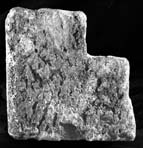
Object type: Altar pillar, cross-base or corner closure slab(?)
Measurements: H. 72 cm (28.3 in); W. max. 28.5 cm (11.2 in) across second horizontal band; D. max. 27 cm (10.6 in) on face D at same point
Stone type: Coarse-grained Millstone Grit with alkali feldspar and quartzite pebbles up to 10mm in dimension. Colour very pale brown (10YR 7/4). Stone provenance as Ripon (cathedral, St Peter and St Wilfrid) 4, but a coarse-grained variety. [J.S.]
Plate numbers in printed volume: Ills. 665-9
Corpus volume reference: Vol 8 p. 238-9
(There may be more views or larger images available for this item. Click on the thumbnail image to view.)
This piece clearly represents the corner of an architectural feature or item of furniture.
A (broad): The face though incomplete is clearly carved in imitation of a wooden 'post and rail' construction. The post and rails are edged, on their complete sides, by roll mouldings. Each 'rail' crosses the whole of the surviving face. The upper 'rail' has three pairs of hollow pointed oval leaves, each pair enclosing a bud. The second, which lies between a quarter and a third of the face from the top, is decorated by a simple horizontal twist. The lowest 'rail' at the foot of the face is incomplete at the bottom as well as on both right and left edges. It is decorated with plain vertical baluster ornament. The 'post' on the left incorporates two vertical rows of zigzag ornament separated by a narrow roll moulding. That on the right is broken and incomplete on its right-hand edge and is decorated by an ornament incorporating parallel diagonal lines: it seems to have had a cable moulding with an inner roll moulding. The face between 'posts' and 'rails' is cut back and dressed smooth.
B (narrow) and C (broad): Cut away and dressed perhaps for its reuse as a step. The removal of a V-shaped section from its internal angle (B/C) almost certainly relates to this use.
D (narrow): The 'post and rail' construction from A is carried through to this face, on which however no trace of decoration survives. It is possible that this side had no other carved decoration.
This piece could be the earliest surviving Anglo-Saxon sculpture from Ripon. It is perhaps significant that it was found in the crypt which has been shown to compare very closely with the crypt at Hexham, the other Wilfridian foundation in Northumbria (Bailey 1991, 3–25) . Its date has been disputed. Its 1962 finder (Pritchard 1973, 265) thought that it had features in common with both Roman and pre-Norman sculpture. Richard Hall (1995, 24), however, has argued that of these two alternatives it must be Roman, since he thought there was no reason to doubt that it was part of the original building of the crypt. Decorated steps are not in themselves improbable at this period, however, as at the Hypogée des Dunes, Poitiers, a partly underground funerary oratory of the seventh century (Hubert et al. 1969, pls. 68, 70). On the other hand, repairs to steps are often necessary, and it is not improbable that a monument was broken up and reused in a later medieval repair.
Rosemary Cramp (1974, 134, 136), in her study of St Wilfrid's church at Hexham, recognised the number of details Ripon 8 has in common with other early Northumbrian sculpture with a Wilfridian connection. In particular I would point to the diagonal line or cable ornament, and the line or baluster ornament, and also to its representation of a 'post-and-rail' construction, all of which are found on architectural pieces from Hexham (Cramp 1984, pls. 182.973–82, 183.983–95). The wider Northumbrian connections of the piece are also interesting in supporting its Anglo-Saxon date. The single twist is found on very early pieces such as the frith stool from Hexham, or the door jambs from Monkwearmouth (Cramp 1984, pls. 113.613, 186.1028), but it could also represent the contemporary taste for Germanic metalwork ornament, like the zigzag motif which is found frequently on fine metalwork of the sixth to eighth centuries, not least on the jewel found in Ripon itself (Hall et al. 1999, 268–80, pl. 8; see p. 14 and Ill. 860). The fragment of cross-head from Ripon, no. 2 above (p. 234, Ills. 637–44) also has this zigzag border, combined on its other face with a spine-and-boss motif in the centre. I have indicated the Bernician and also the metalwork influences in connection with this cross-head. The pellet-and-leaf decoration is also particularly interesting as it represents one half of the pattern unit found on the imposts and frieze of the chancel arch at Ledsham (no. 5, Ills. 471–5). Like this work it dates to the earliest period of pre-Conquest sculpture, defined by Cramp (1978a, 6) as the phase in which the sculpture stays closest to its late antique, early Christian Mediterranean models.
Cramp (1976, 266) thought it a possible altar pillar, and dated it by reference to a seventh-century altar from the Visigothic church of San Vicente in Cordoba, Spain, with which its form and ornament do indeed have many points in comparison (Palol and Hirmer 1967, 468, pl. 17; see Ill. 866). With its imitation of a 'post-and-rail' construction, however, it could be a (corner) closure slab, or it could be part of a cross-base.
