Select a site alphabetically from the choices shown in the box below. Alternatively, browse sculptural examples using the Forward/Back buttons.
Chapters for this volume, along with copies of original in-text images, are available here.


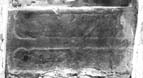
Object type: Grave-marker or -cover [1]
Measurements: L. (max. visible) 68 cm (26.8 in); W. (max.) 38 cm (14.9 in); D. (max. visible) 12 cm (4.8 in)
Stone type: Sandstone, clean, buff-brown colour, coarse to very coarse, quartzose with subordinate feldspar grains and pervasive silica cement. Upper Carboniferous, Millstone Grit Group. [G.L.]
Plate numbers in printed volume: Ill. 670
Corpus volume reference: Vol 8 p. 238
(There may be more views or larger images available for this item. Click on the thumbnail image to view.)
A slab with a cross in very shallow relief. It has a slender stem and a head of type D9.
It is very difficult to date such plain cross-slabs, even when, as in this case, the form of the cross can be found on pre-Viking monuments (see for example Dewsbury 9 and Ilkley 4a: Ills. 219–20, 345–7). Grave-markers with crosses have been dated to the pre-Viking period (eighth to ninth century), partly based on the form of the cross and style of carving, at York Minster, for example (Lang 1991, 67–9, nos. 27, 29, ills. 111, 121). At Hexham, Northumberland, two grave slabs on a larger scale than this, one with a cross of an early Anglian form, have however been dated to the tenth or eleventh centuries (Cramp 1984, 182–3, nos. 16, 17, pl. 181.970–1). In this case, the form and slender proportions of the shaft, and the scale of the slab which seems similar to the York examples, may just suggest the earlier date.
