Select a site alphabetically from the choices shown in the box below. Alternatively, browse sculptural examples using the Forward/Back buttons.
Chapters for this volume, along with copies of original in-text images, are available here.


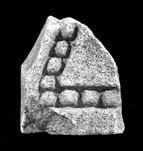
Object type: Fragment of cross-arm [1]
Measurements: H. 11 cm (4.3 in); W. max. 9 cm (3.5 in); D. max. 11 cm (4.3 in)
Stone type: Sandstone, pale yellowish brown, coarse to very coarse grained, quartzose, with kaolinite patches throughout. Sparse granule-grade quartz grains. Carboniferous (Millstone Grit Group). [G.L.]
Plate numbers in printed volume: Ills. 650-4
Corpus volume reference: Vol 8 p. 237
(There may be more views or larger images available for this item. Click on the thumbnail image to view.)
A corner of one arm of a cross.
A (broad): The arm is edged by a smoothly dressed flat moulding, within which is a second pelleted border. The surviving part of the face is dressed smooth.
B (narrow): Broken, showing part of a surviving dowel hole.
C (broad): Only three pellets survive, but this face clearly had a similar layout to A.
D (narrow): Dressed smooth, perhaps for reuse.
F (bottom): Dressed smooth, and the dowel hole is also visible on this face, suggesting it is part of the lower arm of a cross-head.
Both fragments of cross-heads, Ripon 5 and 6, compare directly with the remaining lower arm of the major surviving cross from Hexham, the so-called 'Acca's cross' (Cramp 1984, 174–6, no. 1, pls. 167.896–7, 168.898–9, 169.900–4). Tweddle (1996, 129) also compared Ripon 6 to a stone from St Mary Bishophill Junior, York, no. 4, a plain shaft with a pelleted border, to which Lang (1991, 85, ills. 220–3) assigned a late ninth/tenth-century date. Tweddle thought an eighth-to ninth-century date likely, in view of the links between Ripon, Hexham and York. These links could possibly suggest an earlier date, however. The influence of metalwork styles is again apparent in the beaded border of Ripon 6. See also the discussion of Ripon 2, above.
