Select a site alphabetically from the choices shown in the box below. Alternatively, browse sculptural examples using the Forward/Back buttons.
Chapters for this volume, along with copies of original in-text images, are available here.


Object type: Part of shaft [1]
Measurements: H. 43.8 cm (17.2 in); W. 40.3 cm (15.8 in); D. 17.8 > 15.8 cm (7 > 6.2 in)
Stone type: Fine-grained sandstone, having distinct bedding planes sub-parallel to the front face with joints at right angles to the bedding. A light grey colour (10YR 7/2). Possibly reused stone from nearby Roman York, certainly Coal Measures Sandstone, Westphalian, Upper Carboniferous. [J.S.]
Plate numbers in printed volume: Ills. 35-9
Corpus volume reference: Vol 8 p. 99-100
(There may be more views or larger images available for this item. Click on the thumbnail image to view.)
A slab or shaft of rectangular section, the taper only evident on the narrow faces. It is dressed flat on the top, and how or whether it would have continued above is unclear.
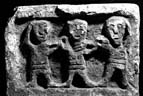
A (broad): Three frontal figures stand in a deeply recessed panel which takes up slightly more than half of the face. The panel has a damaged broad flat edge above and on the left: that on the right is damaged but possibly cut into by the arm of the right-hand figure. Each figure stands with his legs apart and feet turned outwards.
Above the legs of each is a double incised band, perhaps representing a belt — very reminiscent of the single figure on Bilton In Ainsty (St Helen) 2Ci. All have large heads with a flat top, and a narrowing but blunt-ended face with slit mouth, and on the right-hand figure the eyebrows, nose and eyes all show some attempt at modelling. There is no clear trace of hair or halo. The left-hand figure is set in from the edge, and raises his right hand to the side of his head. His left arm is linked to or holds the right arm of the central figure, who appears to be held at the neck by the large hand of the right-hand figure, while his hand rests on the right-hand figure's shoulder. The right-hand figure, who raises his left hand to his head, mirroring the outer figure on the other side, has two incised circles on his breast, reminiscent of the ones on the left-hand figure of Bilton In Ainsty 2Aii (Ill. 40). Below, the rest of the surface is dressed but plain.
B and D (narrow): Both faces are worn and hacked away. B shows traces of a very abraded plait.
C (broad): The broad flat border at the top is cut by five and a half simple arcades, or possibly it could be seen to have five pendant triangles: it rather resembles one row of tegulation type 2b. There is apparently no border on the right, while that on the left is damaged or worn away. An eight-cord basket plait with broad flat strands, very worn, fills the whole face.
The most common identification of the three figures on face A has been the Three Children in the Fiery Furnace, from Daniel 3, 20–8 (Morris 1911, 106; Collingwood 1915a, 141) although Bailey (1980, 155) added the rider that it is only possible to make the identification by reference to parallels in continental art. However, scenes of the Three Children can only be identified by a representation of the furnace, a protecting angel, and/or men bringing faggots to heap on the fire (see e.g. Schiller 1969, pl. 424), and at least one of these features is present on examples in Ireland and their parallels (Harbison 1992, III, figs. 755–63). None is present here, although it could be argued that the angel might have been represented separately, above the figures.
The paired figures on Bilton 2 and the triplet here on Bilton 3 invite comparisons with Aycliffe and Gainford in co. Durham, and in the suggestion of ecclesiastical patronage implied by all the monuments at this site, this is a useful comparison though there is not necessarily any direct connection. There, these scenes are interpreted as Scandinavianised interpretations of the paired saints and apostles on the early cross from St Andrew Auckland, also co. Durham (Cramp 1984, 37–8, 42, 44, 45, 80, 81).
However, as for Bilton In Ainsty (St Helen) 2 above, it is possible that new sources of influence through the medium of Irish-Norse connections were brought to bear. The scene on face A on this cross could, like that on Bilton In Ainsty (St Helen) 2, be an attempt to portray one of the scenes from the Arrest of Christ: in this case possibly the Second Mocking of Christ, or Ecce Rex Iudeorum (Matthew 27, 27–31) as also found on Irish high crosses. See, for example, that on Muiredach's Cross, Monasterboice, Co. Louth (Ill. 868), or portrayed in a simpler and more static way, with less apparent differentiation of the dress of the figures, on crosses from Arboe, Co. Tyrone or Drumcliffe, Co. Sligo (Harbison 1992, III, figs. 875, 878–9). Nevertheless, the simplicity of the figures leaves room for doubt over any identification. Continued and high-level ecclesiastical input is however implied by the fact that the stone for all four Bilton sculptures was imported into the site.
If the upper edge represents tegulation this is interesting as it implies influence from the hogback type of monument, even though this piece is clearly not a hogback, and also that it is complete in height, in which case its function is uncertain. Its subject, if correctly identified, would be unusual for a grave-marker, however.
