Select a site alphabetically from the choices shown in the box below. Alternatively, browse sculptural examples using the Forward/Back buttons.
Chapters for this volume, along with copies of original in-text images, are available here.


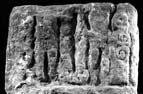
Object type: Lower part of shaft [1]
Measurements: H. 74.5 cm (29.3 in); W. max. 52.6 > 49.8 cm (20.8 in); D. 31.8 > 26.5 cm (12.5 > 10.4 in)
Stone type: As Bilton In Ainsty (St Helen) 2
Plate numbers in printed volume: Ills. 31; 53-6
Corpus volume reference: Vol 8 p. 100-1
(There may be more views or larger images available for this item. Click on the thumbnail image to view.)
The base of a large rectangular limestone shaft. The extensive plain area at the bottom of all faces, more than half of the surviving height, was clearly meant for insertion into the ground, as it was found. The carved faces have damaged borders, probably originally flat.
A (broad): Two figures on the left and right are frontal or possibly turn inwards. They are very battered and do not survive above the torso. Between them are two vertical features which they may be holding or reaching towards. These are possibly the legs of a taller central figure, but this is uncertain. There are traces of interlacing decoration framing the scene on the left, and elements of a stylised scroll on the right.
B (narrow): Within the vertical borders and with a lower incised border is an interlace with broad flat strands, incorporating crude loose pellets, which could however be the background which has not been cut away. The terminal looks like a crude attempt at a Stafford Knot (simple pattern E), joined by a short glide to one loop of half pattern C.
C (broad): The badly hacked remains of flat-band interlace or plait.
D (narrow): Very worn, but the lower corners show the cross-joined terminals of heavy interlacing bands, feeding into a pattern above, now unclassifiable: it could represent a twist or an attempt at a half pattern.
This has features in common with Bilton In Ainsty 2 and 3. The decorative side framing or infilling to a probable figural scene appears on Bilton In Ainsty 2Ci, the broad flat-band plait on Bilton In Ainsty 3C. The crude figure carving, though battered, is clearly at the same level of crudity. The stone, like that for Bilton In Ainsty 1–3, is imported into the area. The figural scene would be difficult to identify without parallels, having lost its upper half: on its own it could be Longinus and Stephaton (the spear and cup-bearers) or even John and Mary, on either side of a Crucifixion scene. The overall form and layout of the stone are, however, very reminiscent of Barwick in Elmet 2 (Ills. 26–9), to which it is similar in dimensions, while the stone, imported into this site, comes from the same formation as at Barwick, where it is a local outcrop. The iconography of the figural faces on both crosses appears remarkably similar also. The side panels here are also similar in layout to the one remaining side panel on Barwick in Elmet 2. For Barwick 2 it was proposed that the scene represented Adam and Eve hiding their nakedness, combined with the figure of the Lord reproving them after the Fall (above, p. 95) and, with the same caveats, the same interpretation, and the same connections, are probable here. It is not too fanciful to suggest the same hand at work at both sites (Ills. 30, 31). The broad, flat bands and loose pellets all support a date in the Anglo-Scandinavian period.
