Select a site alphabetically from the choices shown in the box below. Alternatively, browse sculptural examples using the Forward/Back buttons.
Chapters for this volume, along with copies of original in-text images, are available here.


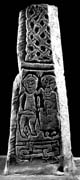
Object type: Part of cross-shaft [1]
Measurements: H. 64.6 cm (25.4 in); W. 28.8 > 17.8 (11.3 > 7 in); D. 15.4 > 14.5 cm (6.1 > 5.7 in)
Stone type: Finely crystalline dolomitic limestone, otherwise as Bilton In Ainsty (St Helen) 1. [J.S.]
Plate numbers in printed volume: Ills. 40-1; 46-9
Corpus volume reference: Vol 8 p. 97-9
(There may be more views or larger images available for this item. Click on the thumbnail image to view.)
An incomplete cross- shaft, probably of rectangular section, although the finished form is difficult to determine as all faces are incomplete in width. The edge moulding survives on the left of A and the top left of C: it is cabled with a pattern of two strands wound around a single thicker strand.
A (broad): This face is incomplete on the right-hand side which has been chamfered to accommodate its reuse as a building stone. The upper panel seems to have no inner moulding, but there is a worn, possibly originally cabled, divider between this and the panel below. The central panel has no border, but the surface around the figures has not been dressed back, leaving the appearance of a crude frame. It is separated from the lowest panel, which has no inner moulding, by a deeply incised line. Both of the two lower panels seem to have an inner flat moulding. (i) In the upper panel is a double-stranded plait, with deeply gouged holes between the strands: probably a six-cord plait. (ii) The figural scene below has two frontal figures. The undressed surface of the panel curves halo-like round the upper part of both heads. The figure on the left has short, tightly curled hair, a pointed, perhaps bearded, face and incised features, with round eyes, the eyebrows and nose cut in a single line and a short slit for a mouth. The eyes however are slightly modelled, like flat round bosses. The hand of his short left arm rests on the shoulder of the right-hand figure. His right arm is longer, and his hand with clearly delineated fingers clutches an object with a straight lower and stepped upper edge which he holds across his body. His garment is short and there is a round boss (a brooch?) in the centre of his breast. His legs and feet turn towards the centre. There may be some object between the two figures, but this is possibly part of the background which has not been cut away. The right-hand figure has similar facial features but no clear trace of hair. His face is slightly less pointed. He wears a long robe with a collar or draped feature round the neck. The position of his arms is not clear, but there are traces of stylised folds of drapery on both right and left. In front of his body is an enigmatic feature, composed of two incised circles, the larger one above, joined by a double-incised line. It is possible that this represents his hands, held in front of him and holding a rod or scroll between them (see Collingham 1Di (Ill. 169) for a more competently rendered expression of this stance). His feet appear below the robe, pointing to the centre. (iii) This narrow panel seems to be complete in width and is possibly almost complete in height, though the lower edge has sustained some damage. It has a maze-like pattern formed from elements, some discontinuous, of meander type 2.
B (narrow): Part of the cable moulding is visible on the right, although it peters out at about the level of the second panel. The left-hand side is chamfered away. There seems to be no divider between the two panels.
(i) A loose interlace with widely spaced strands, including a bifurcating strand and two loose ends which seem clearly to end in feet, therefore legs. This was probably an animal involved in interlace, although Collingwood's drawing and his text which interprets this as a tall, loose-limbed animal with a long neck turned back over its body (1915a, 141, fig. e) cannot be fully confirmed from the remains. (ii) A basket plait with broad flat strands. It becomes irregular near the bottom of the panel, as Collingwood's drawing suggests. The joined terminals are very tight and flattened, suggesting a panel border.
C (broad): The upper panel on this face is incomplete at the top and on the right; the lower at the bottom and on the right. The two panels are separated by an incised line. The surviving surface is the sharpest and least damaged of the piece. The cable moulding is visible on the left. (i) The feature on the left seems to be an inner border from which sprouts two downward curving leafless volutes, probably a decorative filler. In the centre is what looks like the lower half of a frontal figure with a bar/band across his legs at the top. The features on the right are indecipherable. (ii) Below is a double-stranded basket plait, possibly a four-cord plait. There is an illogically terminating strand at the top, and the strands become wider and more regular in crossings lower down.
D (narrow): (i) The upper part of this face is almost completely hacked away, although some of the cable moulding survives on the right, and what appears to be some of the surface in the upper half. (ii) The lower panel has at the top right a figure in a short tunic facing left; he appears to be holding something out to or towards a figure or object on the left, now completely indecipherable. The figure on the right stands on or over a curious shape like an anchor on a stem, but as on other faces some of this form may be surface which has not been completely cut away. There is a large incised step-pattern below this, with three elements on the left and two on the right. This is difficult to interpret and the carving on this face may be unfinished.
Collingwood (1915a, 139–41) saw the figural scene on face A as the Sacrifice of Isaac, and that on face D as 'Moses striking the rock'. The meaning of the latter scene, like that on face C, is however completely irrecoverable in its present state. The scene on face A may be as Collingwood'says, but the figure on the right — who would be Isaac — is elaborately robed, unlike the attacking figure on the right with its short dress. Several New Testament scenes suggest themselves. Peter cutting off the ear of the servant Malchus (John 18, 10–11) at the arrest of Christ is perhaps the least likely, since though Malchus can be shown carrying a staff as on a ninth-century ivory in the British Museum (Schiller 1972, pl. 166), we expect that he should be the figure in the short dress, and Peter the robed. In a late tenth-century Reichenau manuscript, the Codex Egberti, however, those arresting Christ are also in long robes, perhaps because they were interpreted as more than servants of the High Priest, and Peter's knife is in outline very much like the implement carried by the figure on the left here (ibid., pl. 169). The scene could however relate to a different part of the Arrest of Christ, in fact to that part of the narrative which Harbison (1992, I, 265–6) suggests should more properly be called the First Mocking of Christ (Mark 14, 65), in which Christ is shown with his hands bound in front of him, and turned towards one of his mockers. Hands bound or holding an object between them are a much more likely explanation of the feature in front of the right-hand figure than Raine's suggestion (1870–2, 177) that it is a rare example of the 'spectacle' ornament found on Pictish sculpture in Scotland. There are several examples of the Mocking scene on Irish high crosses, for example on both the Tall Cross and Muiredach's Cross, Monasterboice, Co. Louth (Henry 1967, pl. 79; see Ill. 868), and the Cross of the Scriptures, Clonmacnois, Co. Offaly (Harbison 1992, III, figs. 865, 866, 868). At Bilton there is only one mocking soldier: but the curiously shaped object in his hand could have been intended as a bundle of withies for beating rather than a sword or knife. There is little room for another figure, but an abbreviated scene with only one attacking figure is a possibility on another Irish cross, at Ardane, Co. Tipperary (ibid., II, pl. 44).
Collingwood (1915a, 141) also compared this cross with Stonegrave 1, east Yorkshire, and placed both in the eleventh century because of their supposed Scottish influence. This is interesting because Lang (1991, 215–16, ills. 833–6) saw the Stonegrave cross both as outstanding in its local area, and as having features suggesting both Celtic influence and westward leanings, including details in common with other west Yorkshire sculptures at Gargrave, Leeds and Ripon. He saw Stonegrave 1 as evidence of ecclesiastical patronage continuing into the Anglo-Scandinavian period, and perhaps evidence for monastic or church links across the north of England, extending to Ireland, Wales and Galloway. It is interesting in this connection that Bilton 2 appears to be limestone of the same provenance as Bilton In Ainsty (St Helen) 1, implying patrons with the ability to transport new stone some distance, or with access to Roman building stone from York. It is worth emphasising that this cross, though enigmatic in some respects, and crudely carved, appears to have had an ambitious figural programme.
