Select a site alphabetically from the choices shown in the box below. Alternatively, browse sculptural examples using the Forward/Back buttons.
Chapters for this volume, along with copies of original in-text images, are available here.


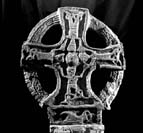
Object type: Cross-head and top of shaft [1]
Measurements: H. 53.2 cm (21 in); W. 47.1 cm (18.6 in); D. 11.5 cm (4.5 in)
Stone type: Fine grained, cellular, dolomitic limestone, very pale brown in colour (10YR 8/3). Cadeby Formation (Upper Magnesian Limestone), Upper Permian. This church is situated on late Quaternary tillite and morainic deposits, so this monument has been directly transported from outcrop to location, or as a reused piece of stone from Roman York. [J.S.]
Plate numbers in printed volume: Ills. 32-4
Corpus volume reference: Vol 8 p. 95-7
(There may be more views or larger images available for this item. Click on the thumbnail image to view.)
A ring-head, type a, with a cross of type B9. The cutting on this head is very fine, the twists and other patterns on the ring being particularly delicate. The background visible on face A was clearly cut back originally and dressed smooth. The carving of the interlace on the sides is fine and rounded, but the figures on the front, though deeply carved, look to have had very little carved surface detail, and the remains of facial features are very crude.
A (broad): The front of the ring is much damaged, and is clearly in worse condition than when Collingwood (1915a, 140, fig. b) drew it, but it is clear that the upper right and lower left quadrant are decorated with a fine-stranded simple twist, the lower right quadrant with a step pattern, type 1, and the upper left with a meander, type 2, all within narrow borders. The ring is stepped, and this face of the crest, though very worn, is clearly decorated: on the lower right quadrant apparently with a raised chevron design (from the top however this is clearly a side view of a damaged cable moulding). Collingwood also noted projections on both side of the lower quadrants of the ring, at the point where they join the lower arm. This is now attested only on the right-hand side, the left is damaged at this point. The cross itself is outlined with a raised flat moulding, and there is a dome-like boss at the centre, with a small central depression which may have been intended to fix a metal covering of some kind over the boss. Within each arm, a frontal human figure stands with his head to the centre boss, his arms raised above his head to grasp the hands of the figure in the adjacent arm on each side, and his legs entangled by a single interlacing band. Collingwood described these figures as clothed and bearded. The heads all have long pointed chins but traces of features survive with certainty only on those at top and bottom. Horizontal traces of clothing are now clear only for the same figures, though all appear to be wearing a short-skirted garment which leaves the legs visible. The top of the shaft survives, and shows a probable animal form disposed horizontally, its ?head at the top left, overlapping the flat border, and its tail or limb developing into interlace on the right.
B (narrow): The side of the ring is stepped in at the edges, to form a crest. On the edge proper, there is a narrow flat band within which are two raised cable mouldings, closer together than they appear in Collingwood's drawing. The end of the arm is outlined by a raised moulding, within which is an interlace pattern, one register of simple pattern B. Pattern elements are visible at the top of the shaft, but these are not clearly the joined terminals of an interlace pattern as drawn by Collingwood.
C (broad): The surface of the cross itself seems completely hacked away, but the ring appears to be decorated in exactly the same way as that at the front: the right upper quadrant certainly has step pattern 1, and the left a fine twist or interlace.
D (narrow): The decoration of the ring is identical to face B. The interlace pattern on the end of the arm is one register of simple pattern E, with the upper of the two Stafford Knots squeezed into the space. The top of the shaft has the joined terminals of an interlace pattern, better preserved than on face B.
E (top): There is no trace of decoration on the end of the upper arm of the cross.
This is a very interesting piece, of which the only clearly Scandinavian feature is the ring joining the arms of the head. In its overall layout and its use of modelled figures, with their heads to the centre in each arm, this has been compared to a cross-head from St Mary Castlegate, York (Lang 1991, 97–8, no. 3, ills. 302–5, 308). Both heads are carved from limestone, and while not from identical formations, a possible source for both is reused Roman masonry from York (see above, and Lang 1991, 97). In York, however, the more highly modelled figures in the arms are crouching quadrupeds; and there are other decorative details which are distinctively Scandinavian. On the Bilton head, all the surviving abstract decoration is Anglian. A possible parallel (to both heads) is a rather cruder fragment of cross-head from Winston on Tees, co. Durham (Cramp 1984, 145–6, pl. 147.772–5: see also the discussion of Crofton 1, p. 125 below). This has human busts facing the centre on the two surviving arms on one face, and stags on either side of the centre on the opposite face, with another animal more conventionally positioned below. Its pelleted border links it with the York head. This Winston piece has appeared to stand apart from others in Bernicia, in its iconography and style of carving, but it implies that the layout at Bilton had a wider distribution than we now see, one perhaps based on a particular influential model, possibly in York.
The repeated figures at Bilton with their entangled feet are now mysterious. A possible interpretation is that they represent figures struggling in hell, a later version of the scene found on the early ninth-century cross from Rothbury, Northumberland, face D (Cramp 1984, 217–21, pl. 215.1224). Bailey regarded this as the best explanation for the entangled figure on the tenth-century Viking-age shaft from Great Clifton, Cumberland (Bailey and Cramp 1988, 110–11, ill. 335). It would seem odd, however, to elevate such a scene to the cross-head. Another cross-head from Cumberland, Brigham 5, has a figure entangled in and grasping interlacing bonds or beasts, perhaps meant to represent Christ triumphant (Bailey and Cramp 1988, 76–7, ill. 144), but the repetition of figures at Bilton makes this less likely. Perhaps a more generalised depiction of men casting off the bonds of sin, and redeemed by the cross, is meant; or the figures represent the four Evangelists, although there is no surviving identifying symbol or feature. The ring indicates a date after c. 920 (Bailey 1978, 178–9).
