Select a site alphabetically from the choices shown in the box below. Alternatively, browse sculptural examples using the Forward/Back buttons.
Chapters for this volume, along with copies of original in-text images, are available here.


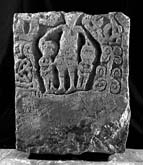
Object type: Lower part of shaft [1]
Measurements: H. 72.4 cm (28.5 in); W. (top) 57 cm (22.4 in); D. 28 cm (11 in)
Stone type: As Barwick In Elmet (All Saints) 1 but not burned. Prominent bedding planes seem sub-parallel to the side faces. [J.S.]
Plate numbers in printed volume: Ills. 26-30
Corpus volume reference: Vol 8 p. 94-5
(There may be more views or larger images available for this item. Click on the thumbnail image to view.)
A broad rectangular shaft, almost slab-like in section, very roughly hacked, with the background cut back only around the various elements, not dressed back to a level surface.
A (broad): About a third of this face at the foot is left plain as a crudely dressed surface, presumably for insertion into the ground or a base. (i) The decorated area above is dominated by a tall frontal standing figure with a pointed face (but whose bearded chin and features, drawn by Collingwood [1915a, 138, fig. e], are no longer clear), with his hands on the heads of two smaller figures. These have their legs pointing to the centre, but their heads are turned outward to the viewer. The figure on the left has its left arm crossing its body, with splayed fingers on the right hip. Its right arm is bent and reaches out to touch the central figure. The right-hand figure is a mirror image, though only the hand of the arm which crosses its body is clear. This central scene is cut back deeply around and between the figures, so that the remaining decorative elements appear separated from it and each other in spaces defined by the relatively shallow cutting-away of the background. (ii) On the lower right is a narrow trapezoidal area with a very stylised and abbreviated bush-scroll, with four pairs of stiffly curling volutes (merely simple curls with clubbed tips). Above this and on the left are various disconnected and irregular fragments of interlace, with one large-scale loop or knot at the top left possibly identifiable as a Stafford Knot (simple pattern E).
B (narrow): This face terminates in a Stafford Knot (simple pattern E) but the strands above seem to develop tendrils, and enclose one stiffly curled volute.
C (broad): On the left is a twist which in Collingwood's drawing (1915a, 138, fig. g) forms a strand at the top which feeds into the irregular, exploded, bush- scroll on the right. The upper part of the stone appears to be more damaged now, and this is no longer so clear. The bush-scroll has three volutes on the left, but on the right has only one symmetrically disposed volute at the top: the lower branches spread and interlace, one ending in a double volute, another in a tri-lobed arrangement like a paired leaf with bud. At the foot on the right is a small animal, apparently a quadruped with a round eye and blunt open jaws: it could be a boar or a dog-like animal.
D (narrow): No surviving decoration
Most interest in this shaft has centred on the figural scene at the centre of face A. Collingwood (1915a, 137–9) compared it to a shaft from Halton, Lancashire (Collingwood 1927, fig. 191; see Ill. 869) and one from Nunburnholme, east Yorkshire (Lang 1991, 189–93, ill. 727). He did not think the scene could be biblical, and suggested the conveying of the Holy Spirit through the laying on of hands, or more specifically the theme of 'Holy Orders'. However the theme of Christ blessing has also been suggested more recently for Barwick 2 and Nunburnholme (Bailey 1980, 156–7), and this has to be considered a probable interpretation in the absence of a clearly diagnostic feature, such as an identifiable snake. Lang (1976b, 90), on the other hand, differentiated the Barwick scene from that at Nunburnholme (which he thought could be a Crucifixion scene), believing that it may instead have been intended to convey the creation of Adam and Eve. This is not impossible, but Lang identified a shaft in the North Riding, Coverham 1, as having a scene with God, Adam and Eve and a serpent head representing the Fall; and another, Spennithorne 1, as a second possible example of the same theme (Lang 2001, 83, 197–8, ills. 125, 746). The range of features and overall arrangement of the scenes on both these shafts certainly invite comparison. The plant form next to the Barwick figures would then represent the Garden of Eden, and one of the interlacing forms might represent the snake. Both the smaller ancillary figures are frontal and can be interpreted as hiding their nakedness. Scenes of Adam and Eve knowing their nakedness occur quite frequently on the Irish high crosses (see Harbison 1992, I , 191–3, III, figs. 660, 663–6), where, however, they are usually shown on either side of a tree (Ill. 867): the stylised trees on some crosses, however, also have something in common with the Barwick example (see for example Harbison 1992, III, figs. 665–6). A scene showing God reproving Adam and Eve after the Fall is found on fol. 5v of the Moutier-Grandval Bible of c. 834 (ibid., fig. 669);[2] and Harbison (1992, I, 193, III, fig. 667) notes one possible Irish representation of this, on the North Cross at Graiguenamanagh, Co. Kilkenny. In this Irish scene, and in the manuscript, God stands to the left and Adam and Eve (or possibly just Adam in the case of the Irish cross) on the right. However, the crossed arms of the figures on the Barwick sculpture strongly echo those of Eve in the manuscript (and of Adam in a later mosaic from Palermo, Sicily: Harbison 1992, III, fig. 668). It seems very possible that the Barwick scene conflates these two themes.
Less notice has been taken of the other decorative elements. There are features which have a local context, such as the vertical patterns feeding into each other on face C (see for example Aberford 1A (Ill. 1) for parallel patterns, there a meander and twist). The exploded scroll on face C might link this piece with the 'spiral-scroll school' in Cumbria (Bailey and Cramp 1988, 33–8), another sign of Norse-Irish influence. In this case, however, the influence of earlier Anglian sculpture in the West Riding is also apparent, in the reduced bush-scroll on face A, while the irregular bush-scroll on face C is still in touch with its Anglian predecessors in its mixture of regular volutes and its attempt at a leaf and bud terminal. The free animal on face C could also be a reminiscence of an Anglian inhabited scroll, in the absence of any other indication of a hunt scene. See also the discussion of Bilton in Ainsty 4, p. 100, and Chap. VII, p. 76, for a discussion of the relationships of this shaft.
[1] The following are general references to the Barwick stones: Ryder 1991, 13; Ryder 1993, 140.
[2] London, British Library, MS. Add. 10546. Carolingian, Tours School (see Ill. 863).
