Select a site alphabetically from the choices shown in the box below. Alternatively, browse sculptural examples using the Forward/Back buttons.
Chapters for this volume, along with copies of original in-text images, are available here.


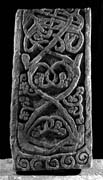
Object type: Lower part of shaft [1]
Measurements: H. 75 cm (29.5 in); W. 37 > 33.4 cm (14.5 > 13.2 in); D. 20.4 > 19.5 cm (8 > 7.7 in)
Stone type: Fine grained cellular dolomitic limestone. Although very dirty this cross-shaft fragment is pale brown in colour (10YR 8/3), but has been slightly burned to create pink surface discolouration in places (5YR 7/3), which is also seen in the broken surface (i.e. cross broken then subject to the slight calcining effects of fire). Upper Cadeby Formation (Upper Magnesian Limestone, Upper Permian of very local origin). [J.S.]
Plate numbers in printed volume: Ills. 22-5
Corpus volume reference: Vol 8 p. 92-4
(There may be more views or larger images available for this item. Click on the thumbnail image to view.)
A cross-shaft of tapering rectangular section. The lower edge of the shaft seems to be present on all faces but the shaft is incomplete at the top. The vertical edges on all faces are edged by flat mouldings, and this type of border is also clearly present at the bottom edge on face B. The lower edges on the other three faces are all treated differently. The sides of this shaft display apparently different carving styles and surface treatments. Faces A and C have relatively open backgrounds and the scrolls have broad flat surfaces which may have been more detailed if painted. The narrow faces have more rounded and deeply-cut double strands and leave little or no free background. There is no sign of these faces having been re-carved, or carved at different times.
A (broad): The lower edge has a narrow, slightly convex, horizontal band from which depend five tight curls, each with a slightly clubbed tip. This border echoes the curving forms of the scroll above but does not feed into it. Above are two elements of a medallion plant-scroll, of which the main stems cross at the foot, each terminating against the side border, with binding below a blunt tip. Each medallion throws off two volutes, one from each stem, which cross-link (to form a heart-shape) in the centre. Each volute ends in what could be flowers with three or more petals, or crude berry bunches. The grapes/petals are separated by crude incisions. Further volutes fill the spandrels between the medallions: the terminations of these are more clearly multi-lobed flower forms. Above the second medallion, on left and right, spring forms which look like thick pointed leaves or buds. At this point the crossing stems of the scroll feed into an interlacing form, some of which is median-incised and some double-outlined.
One strand of the scroll crosses a wider double-outlined strand which terminates in what seems clearly to be an open -jawed animal head on the right, then turns back to pierce the body of the animal, also throwing off an independent curl. The other interlaces with and then becomes the animal's tail. This interlacing of stem and animal is incomplete at the top, and it is not clear how it would develop. The stems and strands of the scroll and interlacing animal are flat. The background is roughly dressed back to a level surface, in which the peck marks of the chisel can be seen.
B (narrow): A regular and competently handled eight-cord basket plait with a fine double strand, which appears more rounded than on face A. The spaces between the strands are deeply punched.
C (broad): This side is much more worn than any other face, and also appears to have been heavily whitewashed, which makes it difficult to interpret. There are space-filling independent curls emerging from the lower side borders. The lowest horizontal form within the panel is similar to the root of the scroll on face A, but is partly double-outlined and the crossed strands terminate in long curls below, which Collingwood (1915a, 136, fig. d) drew as if the framing curls of a head: the feature framed by these curls is very unclear now but it might be a snake head looking up. The elements above which fill the main part of the shaft look like a freer and more stylised version of the scroll on face A, in which an illusion of a medallion scroll is created by a loose strand with curling or clubbed tips, which serves to link the two stems which rise from the 'root' and possibly terminate in a Stafford Knot-like form just below the top. The knot however has clubbed projections on its upper corners and there are indications of the pattern continuing above. The background surface is cut back and heavily pocked; the surface of the carving is flattened as on face A.
D (narrow): The fine double strand on this face is as neatly cut as on B. More of the background is visible here and although it is still rough it seems more finished than on the other faces. The ornament is formed from a series of interlocking twists. The lowest is a figure-of-eight finishing at the foot with an extra twist reminiscent of a vandyke terminal. Linked through this is the terminal loop of a longer twist which ends without apparently joining in the upper corners of the shaft. At the top, this twist laces through a loose penannular form, of which one terminal is a plant-like tendril, while below this it bifurcates to throw off a scroll-like volute terminating in a tri-lobed tendril.
This is a very interesting piece in its combination of Anglian and Scandinavian motifs. The medallion scroll has its origins in earlier pre-Viking sculpture, of which other late but less crude Anglian versions are found in the West Riding, for example on Collingham 3 (p. 122, Ill. 153), where however it is seen as a Wharfedale feature. Kendrick (1941b, 140) saw the Barwick scroll as combining the final degradation of the Anglian pattern along with a 'faint Ringerike flavour', reminiscent of Scandinavianised taste. The same combination is seen at Staveley (Ill. 713). However, the curling tendrils appear in the earlier Mammen phase of Scandinavian art and the pierced animal on face A has elements of the even earlier Jellinge style with which it overlapped. The animal interlace with bifurcations, double outlining and strands piercing bodies is also found in Manx sculpture and in Northumbrian sculpture with Scandinavian and particularly Norse-Irish influence. The ornament on face A unusually combines elements of a medallion scroll with elements of a beast chain (see Chap. V, pp. 57–8). The interlace on face D has an example of a plant tendril incorporated into an interlace-like twist, a feature which is found widely in Manx sculpture and more rarely elsewhere (see Chap. V, p. 49), for example Lowther 7, Westmorland (Bailey and Cramp 1988, 132, ill. 456). In the West Riding it is also found on Spofforth 1 (Ill. 711).
